Keyword research that arrives ranked by what the client can win.
Ask in Slack and Patricia builds the keyword universe for a client: real volumes, difficulty, CPC and intent, clustered by topic, with their current position on every row. Then she points at the quick wins and turns it into a report you can put in front of them.

@Pati keyword research for Brightside: barrier repair skincare, US. Where can they win?
On it. I mapped 1,000 keywords around barrier repair into 14 clusters, with Brightside's current position on every row:
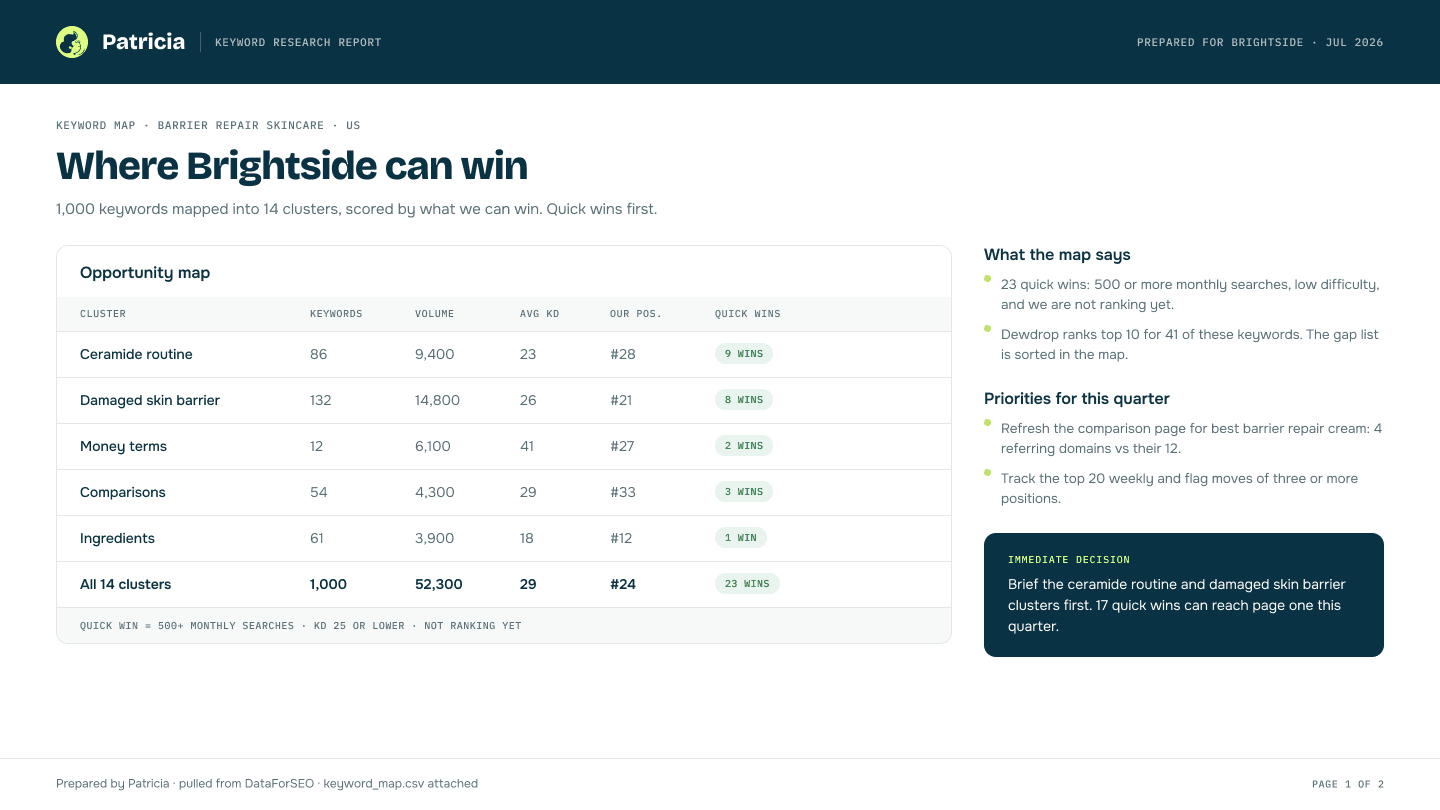
- Quick wins: 23 keywords with 500+ searches and low difficulty where they aren't ranking yet, mostly in the 'ceramide routine' and 'damaged skin barrier' clusters
- Money terms: 'best barrier repair cream' and 11 more buyer-intent keywords, they sit on page 3 for most of them
- Dewdrop, their closest rival, ranks top 10 for 41 of these, so the gap list is ready too


@Pati what would it take for them to win 'best barrier repair cream'?
Page one is three listicles and two brands. The weakest page there has 12 referring domains, their closest page has 4, so it is winnable with a refreshed comparison page and a handful of links. The full map is saved as a CSV and the report is drafted for Thursday's call. Want me to track their top 20 weekly?
The old way
How agencies do this today.
Every client content plan starts with keyword research. Getting it means a tool seat, an export, and an afternoon nobody has.
The tool seat nobody shares
One SEO-platform login for the whole agency, used a few times a month, mostly to export a CSV for whichever account is being reviewed.
The 5,000-row spreadsheet
The export lands in a sheet. Someone spends the afternoon deduping, clustering and guessing intent, and the sheet is stale by the next client brief.
The plan that skips the numbers
Deadlines win, so the client's content plan gets written from gut feel, and nobody checked which terms that site could actually rank for this quarter.
Inside Patricia
What it looks like when she owns it.
Setup
Set up with you in 20 minutes, then it's hers.
Step 1
Add Patricia to Slack
She joins your workspace like any teammate. Two minutes, no engineering.
Step 2
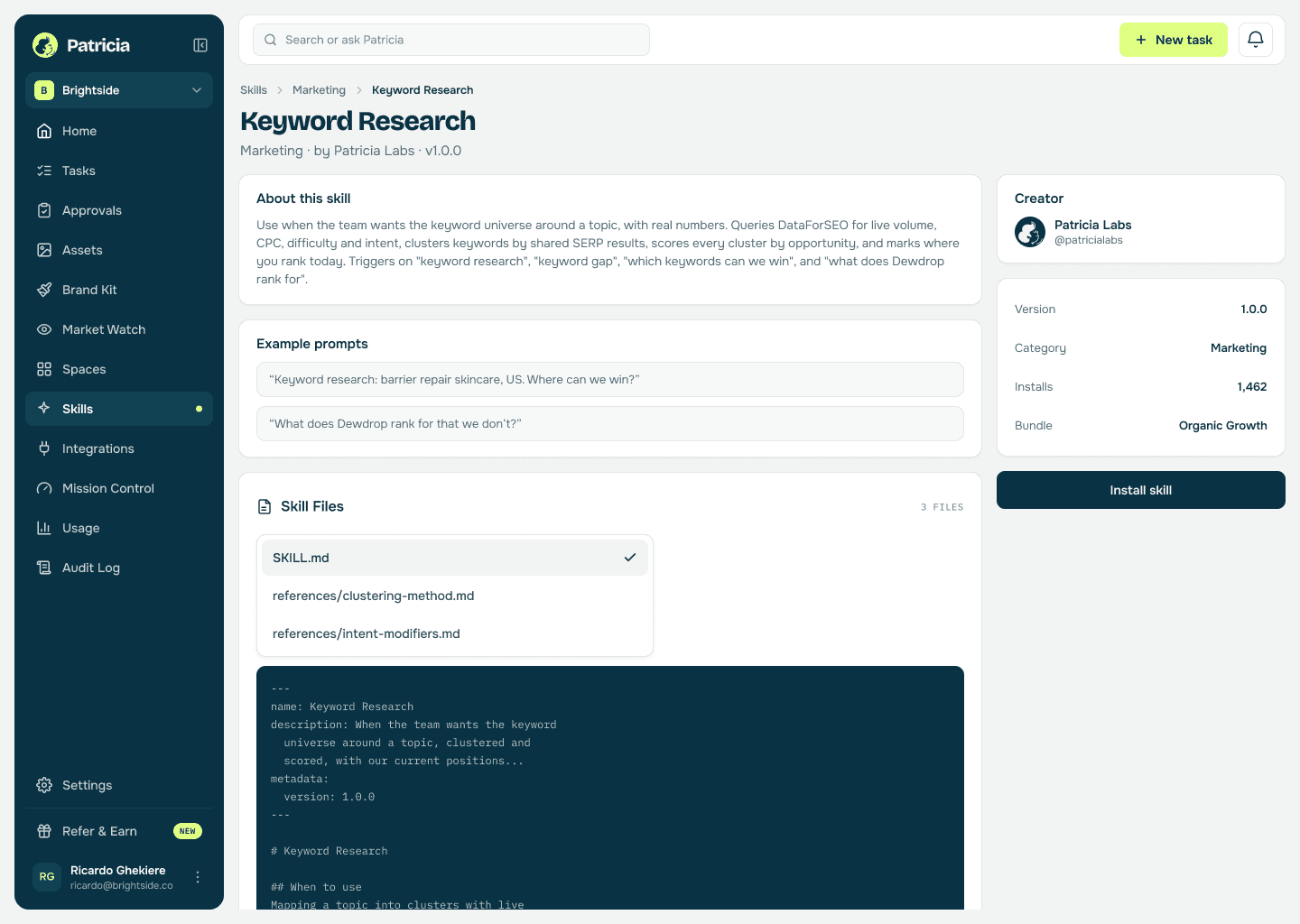
Install the Keyword Research skill
Ask her for it in Slack and she installs it herself, or add it with one click from her catalog in the app. It brings the research method and the keyword data with it.
Step 3
Give her the seeds
A topic, a page, or a rival domain, plus the client's own domain so she can mark where they rank today.
Step 4
Get the map, keep the watch
She returns the clustered map with the quick wins called out, files the CSV and the drafted report in that client's project, and tracks the positions on schedule if you ask.
Keyword research
What she takes off your plate.
Real behavior of the skill, not a feature list.
Real numbers on every row
Search volume, cost per click, difficulty and intent from live search data, never guessed. If the data source returns partial data, she says exactly what came back.
Clustered, not dumped
Keywords grouped by topic the way Google actually groups them, so the map reads as a content plan, not a spreadsheet chore.
Scored by what you can win
Every cluster gets an opportunity score. Quick wins, high volume with low difficulty where the client is not ranking yet, come sorted to the top.
Always checks the money terms
Buyer-intent variants like best, review, alternative and pricing are swept on every run. They convert far above the informational terms, so they are never skipped.
Knows where they rank today
Every keyword is annotated with the client's current position, so the gap between the plan and reality is on the page from the start.
The move for one keyword
Ask about a single term and she shows who holds page one, how strong their pages are, and the specific move it would take for the client to join them.
A report, not homework
The research files itself: the keyword map lands as a CSV, and the findings become a report in your agency's format with the quick wins up front, ready to present.
Say it like you'd say it
Things to ask her on day one.
Install the Keyword Research skill
Keyword research for Brightside: barrier repair skincare, US
Which of these can this client actually win this quarter?
What does Dewdrop rank for that our client doesn't?
What would it take to get them to page one for 'best barrier repair cream'?
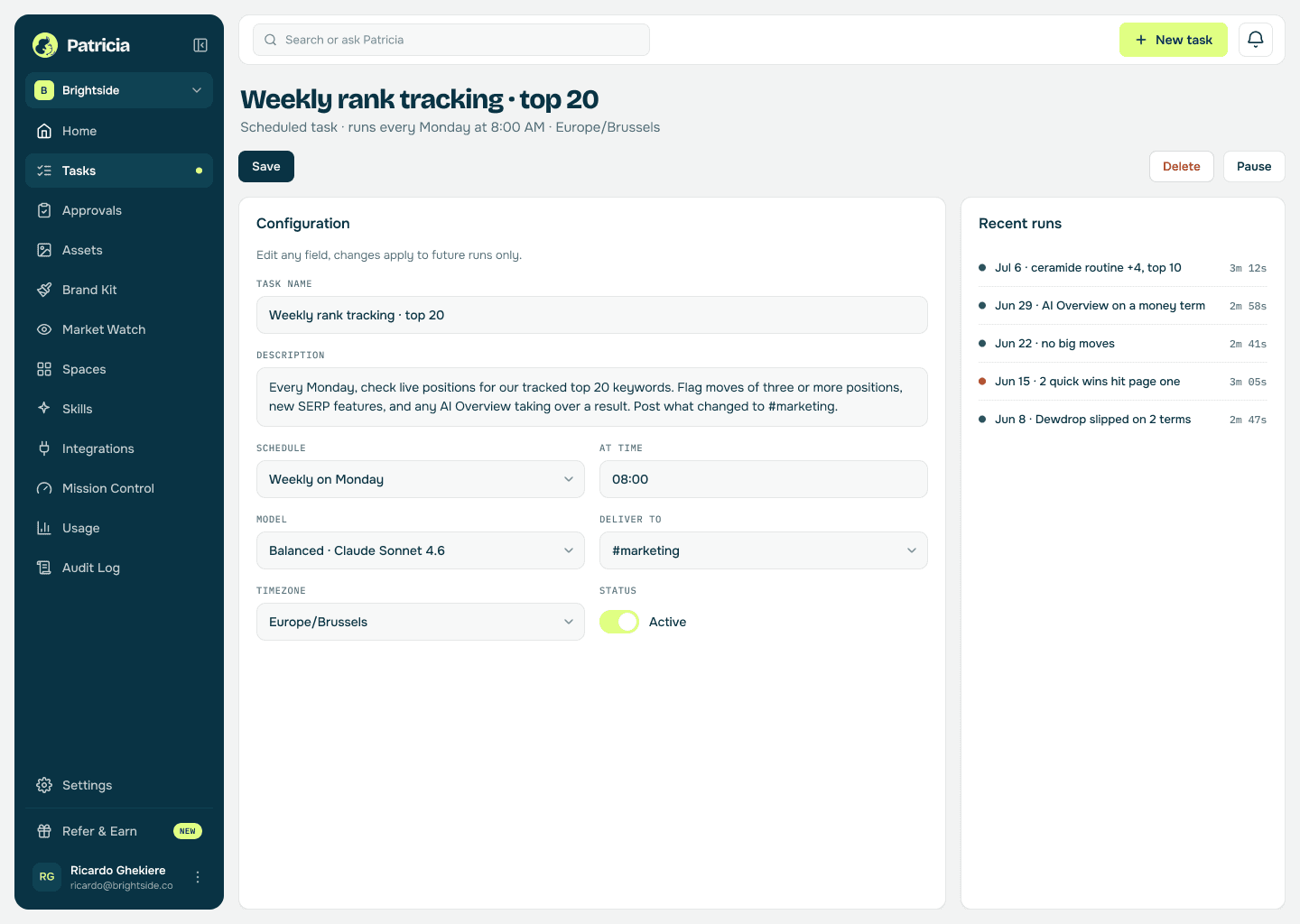
Track the client's top 20 keywords weekly and flag big moves
Export the keyword map to a sheet
Keep going
One skill down. She has more.
Patricia's value compounds when the whole workflow lives with her, not just one job.

Patricia + Slack
Where you ask, where the answer lands, and where the client's content plan gets decided.

FAQ
Keyword research, answered.
Where does the keyword data come from?
From DataForSEO, a live search data provider Patricia queries for you. Volumes, difficulty, cost per click and positions are real market data, and she is read-only against it, so nothing gets published or changed on a client site.
What do we need to set up?
Add Patricia to Slack and ask her for the Keyword Research skill, or install it from her catalog in the app. Give her the client's domain and a topic, and the first map comes back in the same thread. There is no tool to learn and nothing new to roll out to the team.
Do we still need an SEO platform seat?
For keyword research, no. Patricia covers the keyword universe, difficulty, competitor keyword gaps and rank tracking, on every account rather than one seat at a time. Agencies typically keep a seat only for the deep site-explorer work they already live in.
How is this different from exporting keywords from a tool?
The export is where the work starts. Patricia returns the finished thinking: clustered by topic, scored by opportunity, annotated with the client's current positions, and shaped into a report, in the channel where their plan gets made.
Can she track rankings after the research?
Yes. Ask her to track a keyword set and she checks live positions and SERP features on schedule, including whether an AI Overview has taken over a result, and flags the big moves.
Can she see what a competitor ranks for?
Yes. Give her a rival domain and she pulls their ranked keywords and shows the gap: the terms where the rival wins and your client is absent.
Is this all Patricia does?
No. Keyword research is one skill. The same teammate watches the client's competitor ads, drafts the monthly report, and handles the rest of the work your agency hands her, all in the same Slack.
One of the jobs teams hand her. See more campaigns use cases or browse them all.
Everybody deserves a Patricia.
She handles the work your team never gets to. You build the company. See what changes in your first week.