Landing page tests a client account can actually finish.
Ask in Slack and Patricia runs the power math first, so you only test what can reach significance. She specs the experiment as one change split 50/50 for your media buyer to launch, reads Google's own significance instead of guessing, and flags any page that quietly stops matching the ad.

@Pati which landing page tests can Brightside's search account actually finish in the next few weeks?
Ran the power math on their last 90 days. Four tests can hit significance inside six weeks at current traffic:
- An outcome-led H1 and a shorter form: about 1,200 conversions per arm, roughly 3 weeks each
- An action-verb CTA: about 4 weeks
- A new hero image: 6 weeks, tight but doable
- Trust badges and a pricing-layout test need more traffic than six weeks gives, so I would hold those


@Pati spec the outcome-led H1 test, 50/50, and I'll launch it.
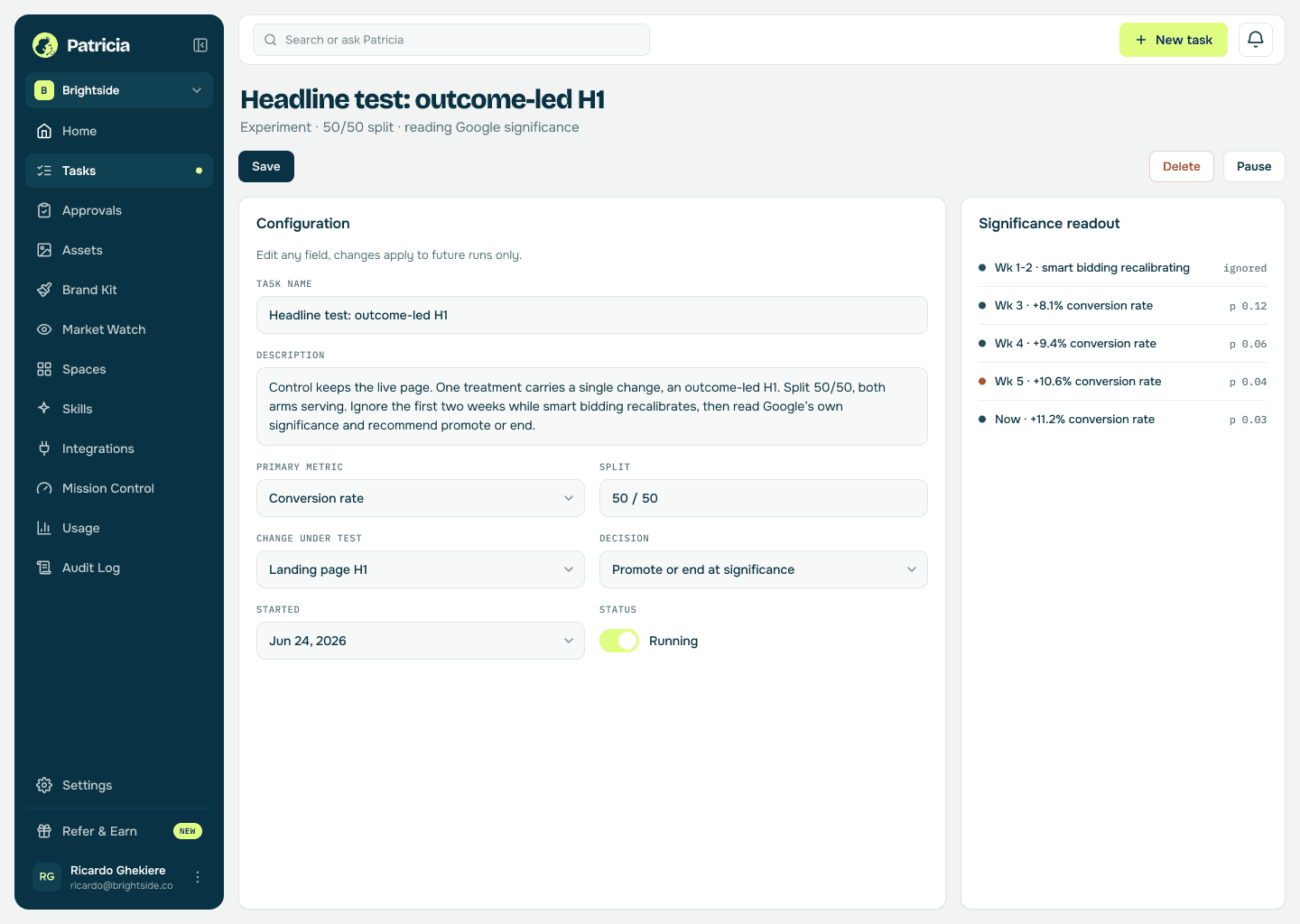
Specced and ready for you. Control keeps the current page, one treatment carries just the new H1, split 50/50. Once you have it live I will ignore the first two weeks while smart bidding settles, then read Google's own significance and come back with promote or end. One more thing: an enabled ad promises a discount the page never mentions. Want me to flag it for a fix?
The old way
How agencies do this today.
Every client wants to test the landing page. Most tests never give a clean answer, and the ones that do get called too early.
The test that never reaches significance
A test ships on a client account without checking whether it has the traffic to ever call it. Weeks later the numbers are still a coin flip, and the decision gets made on gut feel anyway.
The winner called too early
The first week looks great, so the change goes to 100% and into the report. It was smart bidding recalibrating, not a real lift, and the gain quietly disappears the next month.
The page that stopped matching the ad
An ad promises something the client's landing page no longer says, or the page 404s after a redirect. Their spend keeps flowing to it for days because nobody is checking every ad against its page.
Inside Patricia
What it looks like when she owns it.
Setup
Set up with you in 20 minutes, then it's hers.
Step 1
Add Patricia to Slack
She joins your workspace like any teammate. Two minutes, no engineering.
Step 2
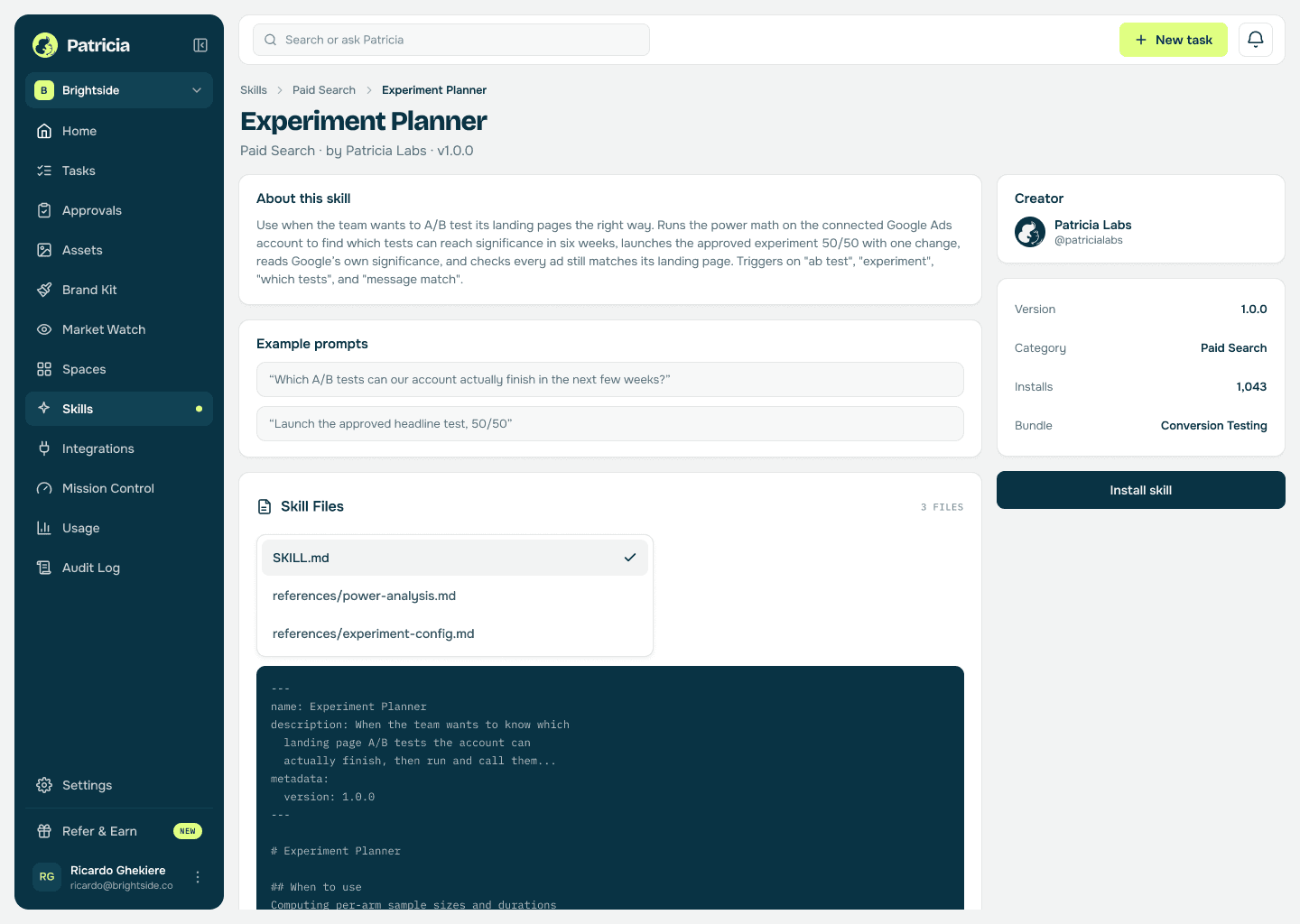
Install the Experiment Planner skill
Ask her for it in Slack and she installs it herself, or add it with one click from her catalog in the app. It brings the power math and the experiment method with it.
Step 3
Connect the client's Google Ads account
One read-only connection. She reads the account stats to compute what can be tested, and she never writes to the account herself.
Step 4
Launch the test, get a real answer
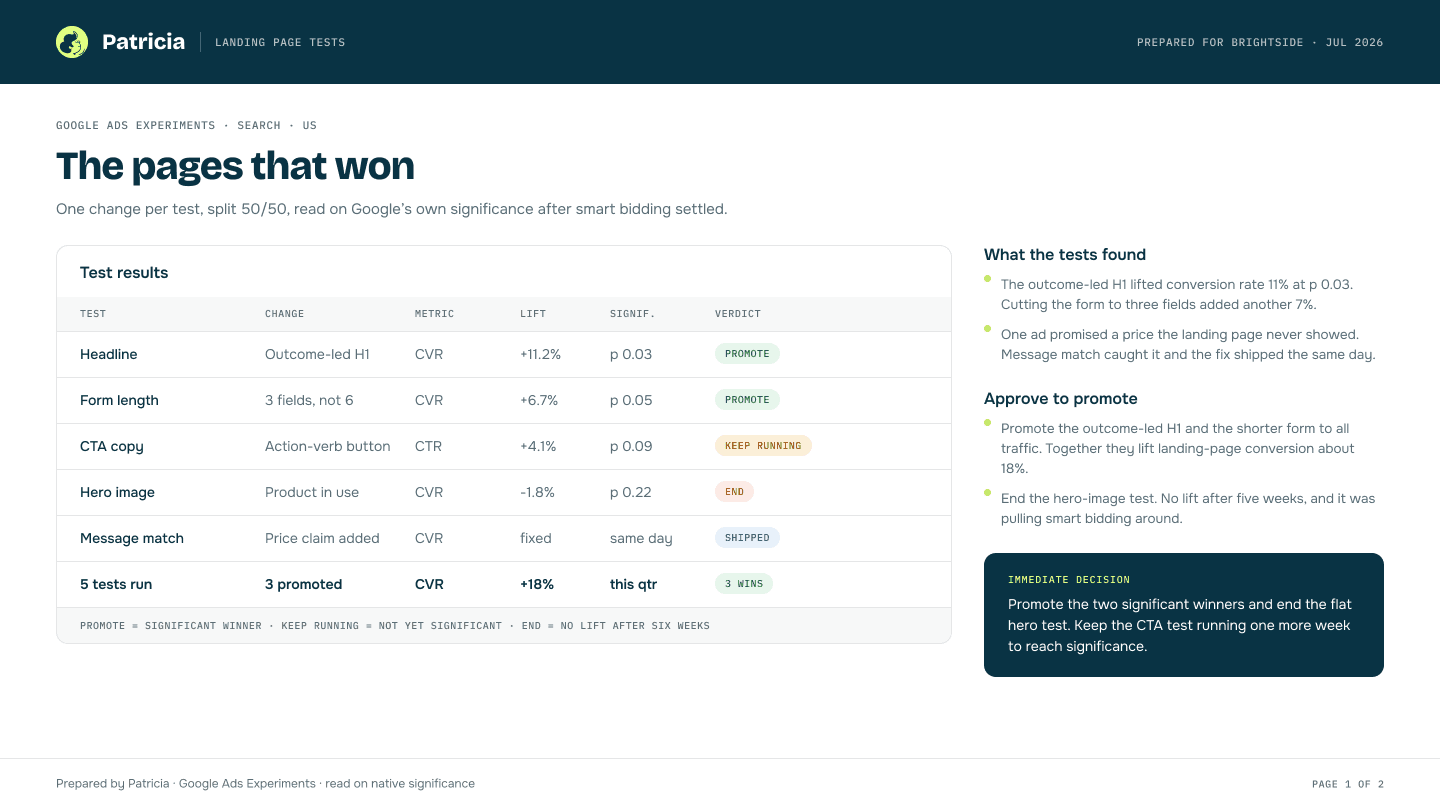
Your media buyer launches the experiment she specced. She ignores the noisy first two weeks, reads Google's own significance, and comes back with promote or end, plus any page that stopped matching its ad.
Landing page tests
What she takes off your plate.
Real behavior of the skill, not a feature list.
Only the tests you can finish
She computes the sample size and weeks each test needs at the account's current traffic, and surfaces only the ones that can reach significance in six weeks. She will not propose an underpowered test, she tells you to grow the traffic first.
One change per test
Control keeps the live page, one treatment carries a single change, split 50/50. One variable means the result actually means something, so the client gets an answer instead of a story.
Read on Google's own significance
She reads Google's native p-value, lift estimate and margin on the metric you chose, not a homegrown calculation, so the call is one you can defend.
Never called early
She deliberately ignores the first two weeks while smart bidding recalibrates, then recommends promote or end only when the planned sample is reached. No first-week false winners in the client report.
Message match, checked every day
She pulls every enabled ad with its landing page and catches the silent killers: dead pages, soft-404s, redirects that leave the domain, and any claim the ad makes that the page never backs up.
Part of the account watch
The landing-page check runs on schedule across the accounts you point her at, so a client page that breaks mid-campaign is flagged the same day, not when someone finally notices the spend.
Read-only, always
She plans, specs and reads. She never writes to a client's account. Launching the experiment, promoting a winner and ending a test are your media buyer's calls, never automatic.
Say it like you'd say it
Things to ask her on day one.
Install the Experiment Planner skill
Which A/B tests can Brightside's account actually finish in the next few weeks?
How long would a landing page test on their search campaign take to hit significance?
Spec the approved headline test, 50/50
Is the Brightside experiment significant yet, or should we promote or end?
Check every ad's landing page still says what the ad promises
Flag any broken or off-message landing pages across our client accounts
Keep going
One skill down. She has more.
Patricia's value compounds when the whole workflow lives with her, not just one job.

Patricia + Slack
Where you ask which tests can finish, get the spec, and get the promote-or-end call.
FAQ
Landing page tests, answered.
Does Patricia change our clients' campaigns?
No. Everything she does here is read-only: the power math, the spec and the significance reading. Your media buyer launches the experiment in the account, and promoting a winner or ending a test is their call too.
How does she decide a test can actually finish?
She runs the power math on the account's last 90 days: the per-arm sample size a 50/50 test needs at 95% confidence and 80% power, and how many weeks that takes at its current traffic. If a test cannot reach significance in six weeks, she says so rather than let you ship an underpowered test to a client.
Why ignore the first two weeks?
When an experiment starts, smart bidding recalibrates and the early numbers swing. Calling a winner in week one is how a lift that was never real ends up in a client report. She waits until the arms settle, then reads Google's own significance.
What is the message-match check?
She pulls every enabled ad on the account with its landing page and checks the page still delivers what the ad promises: the headline terms, the offer, and any claim the ad makes. She also catches dead pages, soft-404s, and redirects that leave the domain, and proposes the fix for your approval.
Do we still need a landing page testing tool?
For planning and calling Google Ads experiments, no. Patricia works out what can be tested, specs it 50/50, reads Google's native significance, and watches message match. Agencies keep a separate tool only for the on-page design work it does that Patricia does not.
Is this all Patricia does?
No. Landing page testing is one skill. The same teammate maps a client's keywords, cleans their search terms, watches the pacing, and drafts the monthly report, all in the same Slack.
One of the jobs teams hand her. See more campaigns use cases or browse them all.
Everybody deserves a Patricia.
She handles the work your team never gets to. You build the company. See what changes in your first week.