Client blog drafts, written and scored before you publish.
Ask in Slack and Patricia drafts from real sources in the client's brand voice, then scores the piece for on-page SEO against the keyword, rewrites the title, meta and headings, checks E-E-A-T, and generates the schema. She hands your writer a draft that is ready to edit, not ready to rewrite.

@Pati draft a post on repairing a damaged skin barrier for Brightside's blog, target 'damaged skin barrier'.
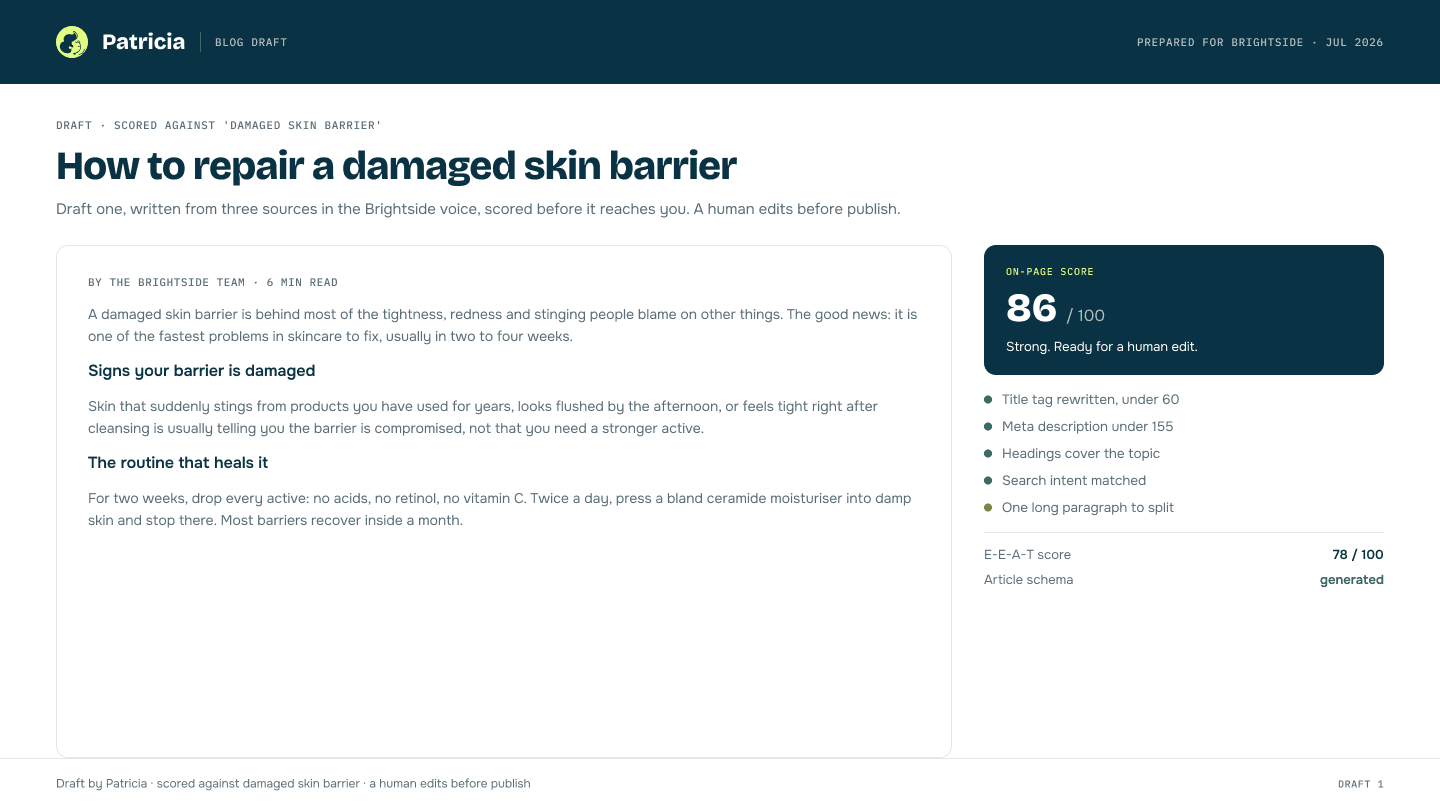
Drafted it, grounded in three sources and their brand kit, then scored it before handing it over:
- On-page score 86: title, meta and headings rewritten with 'damaged skin barrier' near the front, intent matched to the SERP
- E-E-A-T 78: I added an author line and cited the dermatology source, and flagged one claim that still needs a link
- Article schema is generated and ready to drop in
- One for your writer: the intro reads a little generic, worth a human pass before it goes to Brightside


@Pati is Brightside in the best-of roundups for 'barrier repair cream'?
Pulled the live top 20. Brightside is listed in 3 of the 11 roundups, mid-table in two of them. They are missing from 6, including the two that rank on page one. I drafted a short outreach note for each. Want the queue?
The old way
How agencies do this today.
The blog is where the SEO retainer is supposed to happen. It is also the work that slips every single week.
The brief that never becomes a draft
A keyword and a title sit in the client's content plan for a month. Writing the first draft is the expensive part nobody has a spare afternoon for, so the piece never ships and the retainer has nothing to show.
The draft that ignores the SEO
When something does get written, the on-page work gets skipped: the title is too long, the headings miss the term, the intent is off. It reads fine to the client and ranks for nothing.
Published, then invisible
The post goes live with no structured data and no plan to get into the best-of roundups that own the SERP, so it never earns the citations that would actually move the client's rankings.
Inside Patricia
What it looks like when she owns it.
Setup
Set up with you in 20 minutes, then it's hers.
Step 1
Add Patricia to Slack
She joins your workspace like any teammate. Two minutes, no engineering.
Step 2
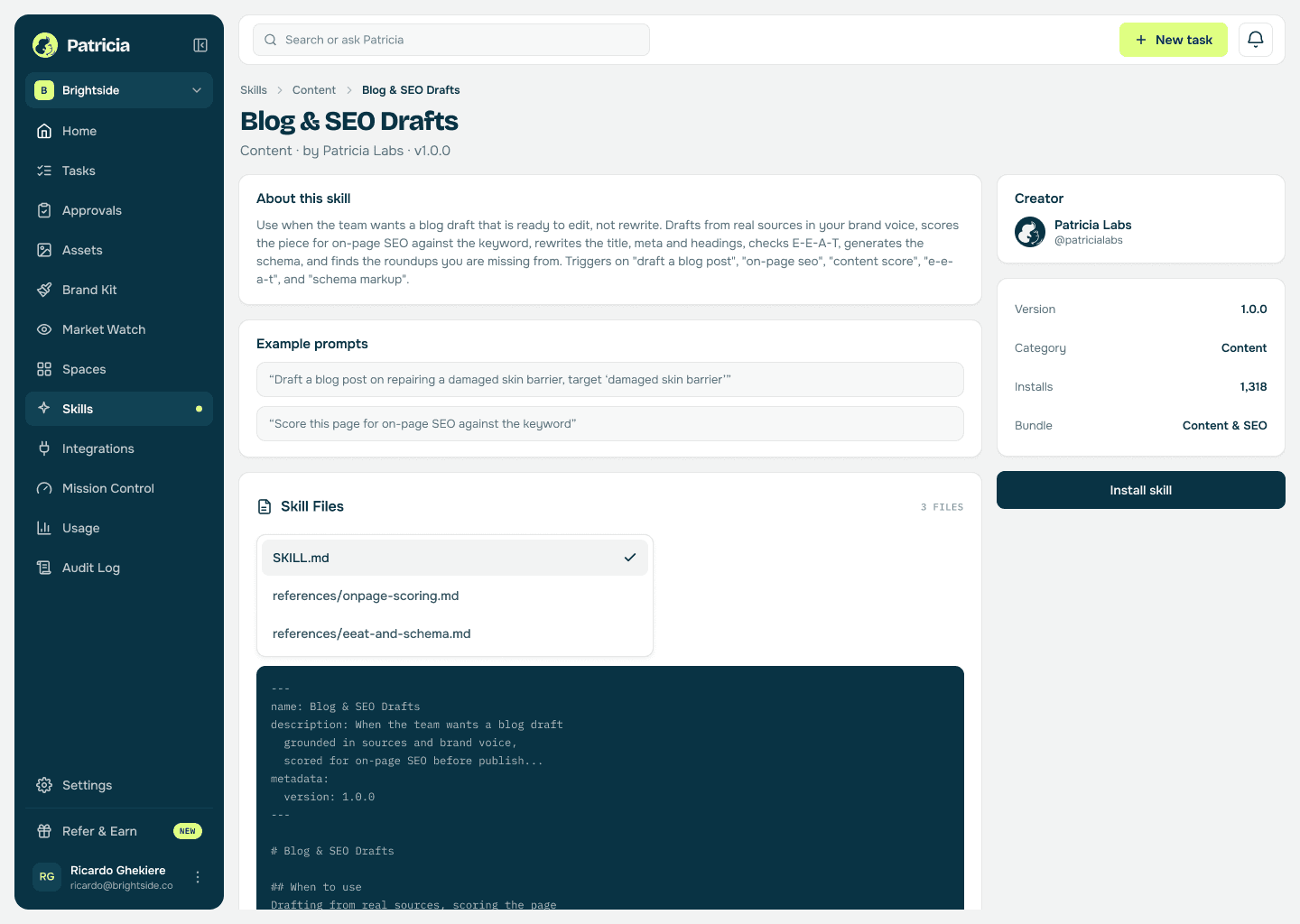
Install the Blog & SEO Drafts skill
Ask her for it in Slack and she installs it herself, or add it with one click from her catalog in the app. It brings the research, on-page, E-E-A-T and schema methods with it.
Step 3
Give her the keyword and the angle
A target keyword and a topic, plus the client's brand kit so the draft comes back in their voice and only makes claims their proof backs up.
Step 4
Edit, approve and publish
She hands back a scored draft with the title, meta and headings rewritten, E-E-A-T checked and schema generated. Your writer does the human edit, the client approves, and a person hits publish.
Blog & SEO drafts
What she takes off your plate.
Real behavior of the skill, not a feature list.
Grounded in real sources
She frames the question, gathers from more than one source, prefers primary, recent and named sources over commentary, and marks any inference as directional. The draft starts from checked facts, not filler.
In the client's brand voice
The draft is written to their brand kit: the voice, the proof to show, and a do-not list. Claims are backed by the client's real proof, so no invented testimonials or numbers slip into their blog.
Scored against the keyword
She renders the page and scores the title, meta, heading outline, coverage and search intent against the target keyword, then flags thin or off-topic sections and keyword stuffing.
Rewrites, not just a grade
She hands back a rewritten title with the keyword near the front and under 60 characters, a meta under 155 that reads as a click prompt, a corrected H1, a fixed heading outline, and a prioritized list of content gaps.
E-E-A-T, checked
She scores Experience, Expertise, Authority and Trust from 0 to 100, weights Trust highest, raises the bar on your-money-your-life topics, and returns the three highest-impact gaps with a concrete fix for each. She never fabricates credentials or citations.
Structured data generated
She detects any existing markup, validates against Google's rich-result rules, infers the right type, and writes clean JSON-LD for the content that is actually on the page, ready to drop into the head.
Into the roundups
For a commercial keyword she reads the live top-20, judges whether the client is genuinely listed and where, and returns the best-of roundups they are missing from as a ranked outreach queue.
Drafts only, you publish
Every step is read-only. She drafts, scores and rewrites; nothing reaches a client site. A person does the final edit and hits publish.
Say it like you'd say it
Things to ask her on day one.
Install the Blog & SEO Drafts skill
Draft a blog post on [topic] for the client's blog, target [keyword]
Score this page for on-page SEO against [keyword]
Rewrite the title tag and meta description for this post
Check this draft for E-E-A-T and helpful-content signals
Generate Article and FAQ schema for this post
Is the client listed in the best-of roundups for [keyword]?
Keep going
One skill down. She has more.
Patricia's value compounds when the whole workflow lives with her, not just one job.

Patricia + Slack
Where you ask for the draft, read the score, and get the roundup outreach queue.

FAQ
Blog & SEO drafts, answered.
Does Patricia publish the post?
No. Every step is read-only: she drafts, scores, rewrites and generates the schema, but nothing reaches a client's site. Your writer does the final edit and a person hits publish. The draft is built to be edited, not rewritten.
How does the on-page scoring work?
She renders the page, strips the nav and boilerplate, and scores the title, meta, heading outline, word count, image alt coverage and internal links against the target keyword and its search intent. Then she returns the rewrites: a title under 60 characters with the keyword near the front, a meta under 155, a corrected H1 and heading outline, and the content gaps in priority order.
Will the draft invent facts or citations?
No. She grounds the draft in real sources and marks any inference as directional, and the E-E-A-T check never fabricates credentials, reviews or citations. If a claim needs a source, she flags it rather than making one up, which matters when the byline is your client's.
What is E-E-A-T and why does it matter?
It is Google's framework for Experience, Expertise, Authority and Trust from its quality rater guidelines. She scores all four from 0 to 100, weights Trust highest, raises the bar on health and money topics, and returns the three highest-impact fixes, like adding an author box or citing the primary source.
Can she help the post actually get found?
Yes. She generates the structured data for rich results, and for commercial keywords she reads the live top-20 to find the best-of roundups the client is missing from and drafts the outreach for each. Structured data plus roundup placement is where a good post earns its citations.
Is this all Patricia does?
No. Blog drafting is one skill. The same teammate researches the client's keywords, drafts their social posts, drafts the monthly report, and handles the rest of the work your agency hands her, all in the same Slack.
One of the jobs teams hand her. See more content & social use cases or browse them all.
Everybody deserves a Patricia.
She handles the work your team never gets to. You build the company. See what changes in your first week.