
How AI coworker pricing works, what one real client month costs job by job, and what the same jobs cost at model API rates.
Patricia bills per workspace: $95 a month with 45,000 credits included and every seat included, then credits for the work at $2.25 per 1,000. In our own workspace, nine recurring jobs for one client used about 24,300 credits in October 2026, which fit inside the plan: about $95 a month. The tokens those runs read and wrote cost about $34 at Claude Opus 5.5 API rates and about $84 at Claude Fable 5.1 rates, before caching, tool costs and the work of building the jobs yourself.
Every Patricia figure below comes from the runs she recorded in October 2026. The API prices are Anthropic's list prices per million tokens, checked on 29 October 2026.
Checked in October 2026How does AI coworker pricing work?
Patricia bills per workspace, plus credits for the work:
- One workspace price. $95 a month on the Agency plan, with 45,000 credits included. Every seat is included, so adding a person costs nothing.
- Credits for the work. A credit meters model time, tool calls and steps. Each task shows a typical cost up front, then bills what it actually took.
- Extra credits when you need them. $2.25 per 1,000 at the base rate, with up to 25% off in bulk. Unused credits roll over.
The bill grows with the work, not with the headcount. So the useful question is what the work costs, and the fair yardstick is what the same jobs would cost at model API rates.
A real client month, job by job
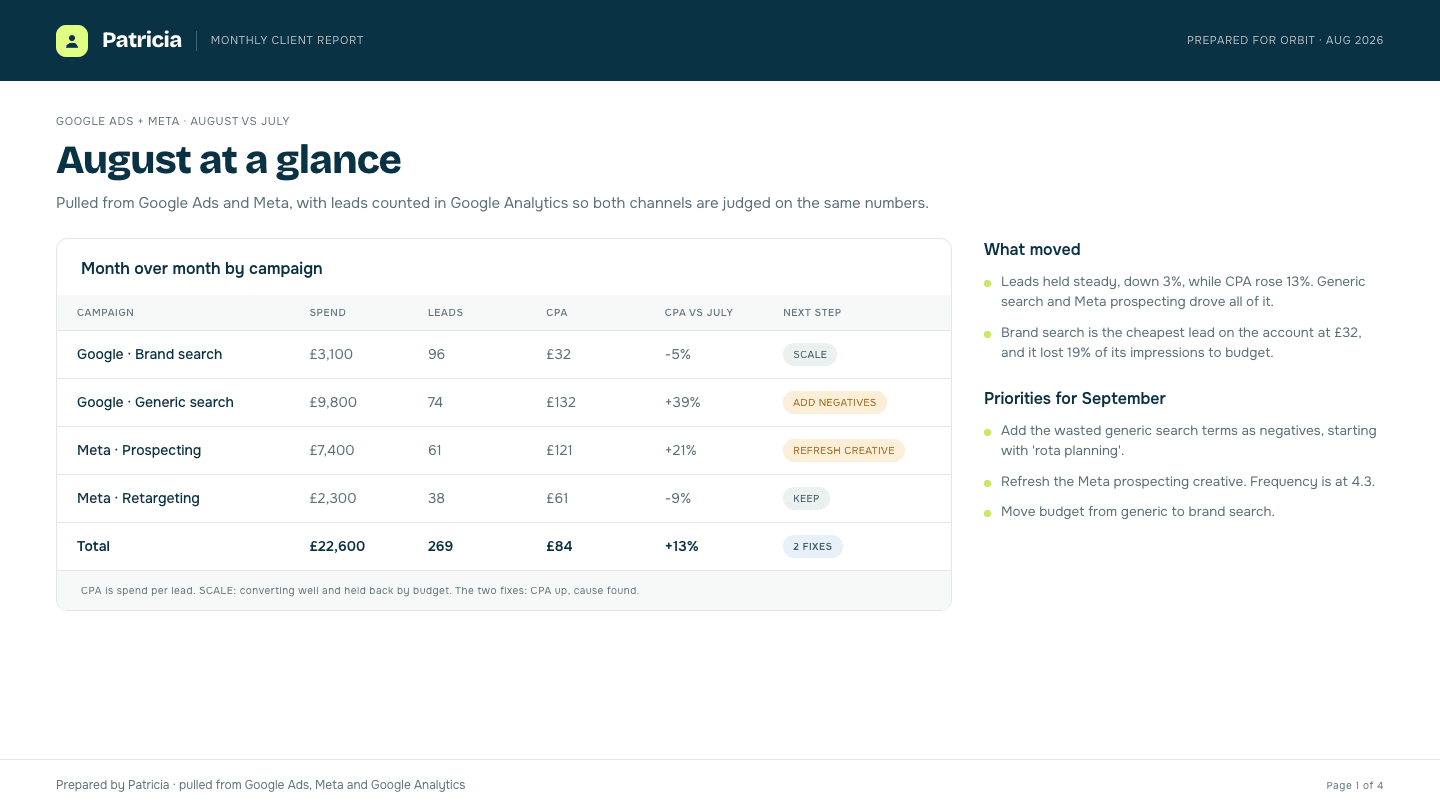
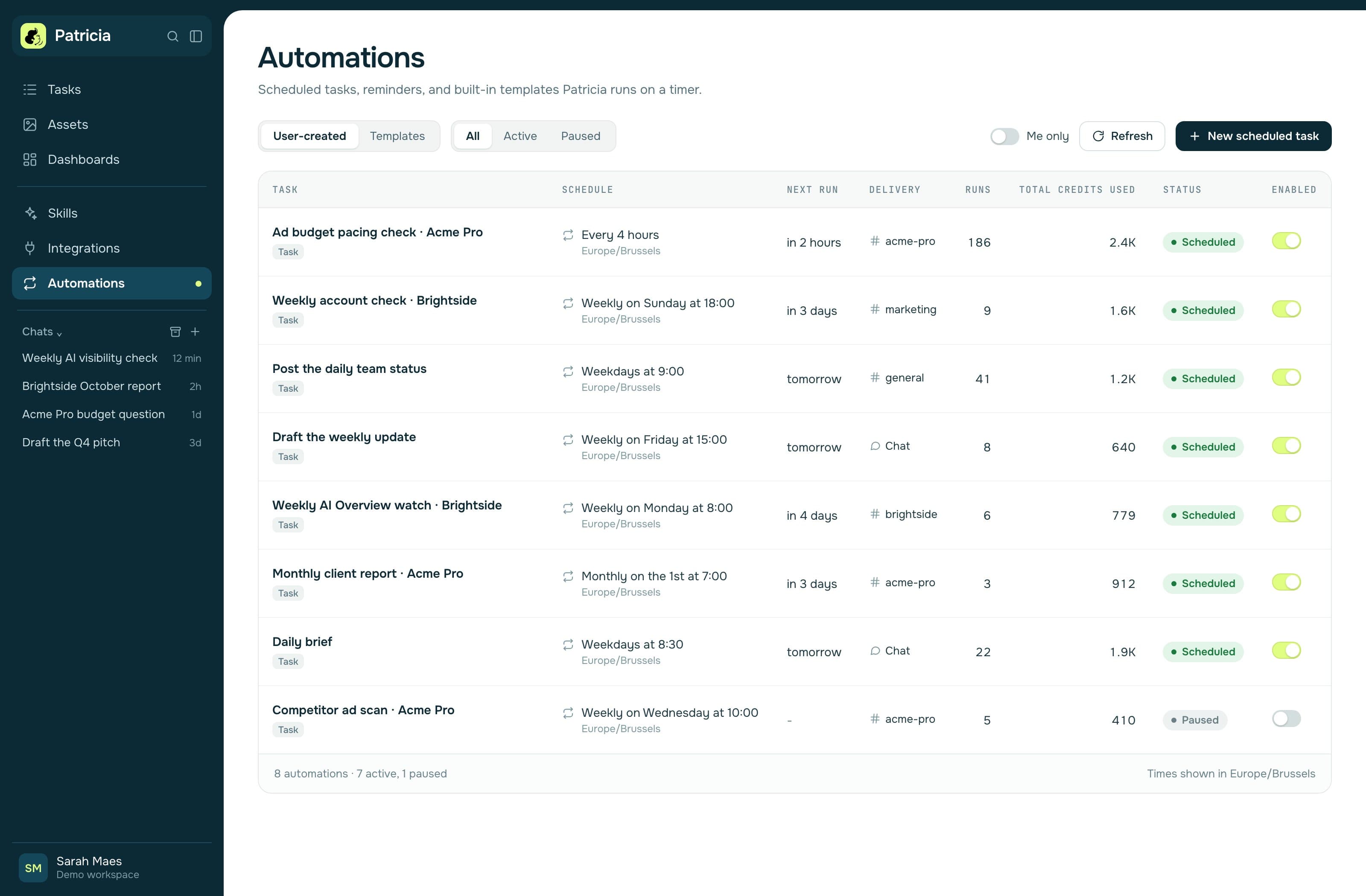
BetterPic, one client, a full SEO and ad loop. BetterPic is our sister company and Patricia's first client. In October 2026 she ran nine recurring jobs for it. Each row is the average of the last three runs Patricia recorded (one run for the Monday search report and the monthly jobs). The API columns price the input and output tokens of the same runs at Claude's list rates.
| Recurring job | Schedule | Patricia, per run | Claude Opus 5.5 tokens, per run ($4 / $20) | Claude Fable 5.1 tokens, per run ($10 / $50) |
|---|---|---|---|---|
| Ad anomaly watch on Google Ads | Daily | about 467 credits ($1.05) | about $0.64 | about $1.60 |
| Roundup and link outreach drafts | Weekly | about 778 credits ($1.75) | about $1.15 | about $2.88 |
| Monday search report | Weekly | about 455 credits ($1.02) | about $0.63 | about $1.57 |
| Page fixes | Weekly | about 425 credits ($0.96) | about $0.62 | about $1.55 |
| Content brief | Weekly | about 271 credits ($0.61) | about $0.34 | about $0.86 |
| Friday follow-ups | Weekly | about 94 credits ($0.21) | about $0.10 | about $0.24 |
| Technical SEO check | Monthly | 625 credits ($1.41) | about $0.86 | about $2.16 |
| Client report | Monthly | 613 credits ($1.38) | about $0.99 | about $2.46 |
| AI visibility report | Monthly | 311 credits ($0.70) | about $0.42 | about $1.06 |
| One month | about 24,300 credits: $95 with the plan | about $34 | about $84 |
Bill for one client: 24,300 credits fit inside the 45,000 included, so no top-up is needed, and the 20,700 left over roll over. About $95 a month.
The same loop for 10 clients: about 243,000 credits. Two 100,000-credit top-ups ($405, bulk rates) cover it on top of the $95 plan. About $500 a month, every seat included. At API rates, the tokens alone would cost about $340 on Opus 5.5 and about $840 on Fable 5.1.
The dollar figure next to each credit count is at the $2.25 base rate. Your jobs can cost more or less.
What the API price leaves out
The API columns are model usage only: the input and output tokens Patricia recorded on each run, priced at Claude's list rates, before caching and tool costs. Running the same jobs yourself on the API also means building and keeping up the schedules, the connections to each client's ad accounts and inboxes, the client memory and the approval step before anything reaches a client.
The model choice matters as much as the rate. If you run a job on one model, every step bills at that model's rate, also the steps a smaller model could do, such as summing up a long thread or sorting a list. Patricia picks the model for each step: a small, cheap model for routine steps such as summing up the context, sorting a request or checking a draft, and a larger one where the work needs judgement.
Keep your own AI tool and let Patricia run the jobs
If your team already uses Claude, ChatGPT or Cursor, keep it. Connect it to Patricia with MCP: people keep working in their own tool and hand Patricia the recurring jobs. Those jobs run on Patricia's credits, on the model each step needs, so they do not use up your own tool's usage limits.
Each tool then does what it is best at. Claude or ChatGPT stays the place where a person thinks a problem through, writes, and asks Patricia for things. Patricia is the orchestrator: she runs the schedules, calls the client's ad accounts and inboxes, remembers the client context, asks for approval, and routes the routine steps to cheaper models. MCP access has no separate price: it uses the workspace credits, like chat.
How do usage-based credits work?
A credit is how a vendor meters work: model time, tool calls, steps. Bigger jobs use more. Every vendor defines its own credit, so the same number of credits buys different amounts of work at different companies. Don't compare credit counts or price per credit across vendors. Run one real job and compare what that job cost.
Patricia's typical costs per task, from our pricing page and the GEO retainer:
- Ad variants and quick drafts: about 56 credits (about $0.13)
- Posts and content briefs: about 150 credits (about $0.34)
- Client reports and research: about 300 credits (about $0.68)
- Campaign builds: about 1,183 credits (about $2.66)
- A monthly AI visibility report on the GEO retainer: about 800 credits per client (about $1.80). BetterPic's lighter version used 311.
Extra credits cost $2.25 per 1,000 at the base rate, with up to 25% off in bulk (2,000,000 credits at 25% off). Credit packs are for paying plans. Unused credits roll over. When credits run out, Patricia pauses and asks.
What should an agency budget for an AI coworker?
Budget for the work, not for the headcount:
- The plan: $95 a month per workspace, every seat included, with 45,000 credits.
- The recurring jobs: list the jobs for each client and multiply by what one run costs. A full SEO and ad loop like BetterPic's costs about $95 for one client and about $500 for 10.
- The biggest job first: the daily ad watch used more than half of BetterPic's credits. Run it on the accounts that move, or less often, and the bill drops.
- Review time: someone approves drafts before they go to clients. Name that person per client and count their time.
Each person can also chat with Patricia privately, in a direct message or the console, on the same workspace credits.
What does a 10-person or 20-person agency pay for an AI coworker?
On Patricia, a 10-person and a 20-person agency pay the same plan price: $95 a month per workspace, every seat included, with 45,000 credits. The bill grows with the number of clients and recurring jobs. In our own workspace, the full nine-job loop costs about $95 a month for one client and about $500 for 10 clients.
Every seat is included, so the tables below count clients and jobs only. They take BetterPic's October 2026 runs from the table above and add the published top-up packs, the same way as the 10-client example.
The full nine-job loop, by number of clients
About 24,300 credits per client a month: the SEO and ad loop from the table above.
| Clients | Credits a month | Top-up packs on the $95 plan | Total a month | Per client |
|---|---|---|---|---|
| 1 | about 24,300 | None: fits in the 45,000 included | $95 | $95 |
| 5 | about 121,500 | one 50,000 and three 10,000 ($174.38) | $269.38 | $53.88 |
| 10 | about 243,000 | two 100,000 ($405) | $500 | $50 |
| 20 | about 486,000 | one 300,000, one 100,000, one 25,000 and two 10,000 ($876.38) | $971.38 | $48.57 |
A lighter loop: the monthly report and the daily anomaly watch
One monthly client report (613 credits) and the daily ad anomaly watch (30 runs at about 467 credits): about 14,600 credits per client a month.
| Clients | Credits a month | Top-up packs on the $95 plan | Total a month | Per client |
|---|---|---|---|---|
| 1 | about 14,600 | None: fits in the 45,000 included | $95 | $95 |
| 5 | about 73,000 | three 10,000 ($67.50) | $162.50 | $32.50 |
| 10 | about 146,000 | one 100,000 and one 10,000 ($225) | $320 | $32 |
| 20 | about 292,000 | two 100,000 and one 50,000 ($511.88) | $606.88 | $30.34 |
Leftover pack credits roll over to the next month. A single top-up between two pack sizes earns the smaller pack's rate, so your bill can come in a little under these totals.
What one completed job costs
- A monthly client report: about 613 credits, $1.38.
- A daily ad anomaly watch: about 467 credits a run, $1.05. At one run a day that is about 14,010 credits a month, the biggest line in the loop.
- The Friday follow-ups: about 94 credits, $0.21.
Dollar figures are at the $2.25 base rate per 1,000 credits.
Are credit-based AI tools unpredictable?
They can be when the meter is hidden. On Patricia you set a monthly spend cap, with an alert before you reach it. Each task shows a typical cost up front, then bills what it took. Unused credits roll over, so a quiet month carries into a busy one. When credits run out, Patricia pauses and asks.
- A spend cap with an alert. You set the monthly cap and get an alert before you reach it.
- A typical cost up front. Each task shows what it usually costs before it runs.
- Rollover. Unused credits never expire.
- A pause when credits run out. Patricia stops and asks, and you choose whether to top up.
 11:53
AI coworker pricing FAQ
What does a 10-person or 20-person agency pay for an AI coworker?
On Patricia, a 10-person and a 20-person agency pay the same plan price: $95 a month per workspace, every seat included, with 45,000 credits. The bill grows with the number of clients and recurring jobs. In our own workspace, the full nine-job loop costs about $95 a month for one client and about $500 for 10 clients.
Are credit-based AI tools unpredictable?
They can be when the meter is hidden. On Patricia you set a monthly spend cap, with an alert before you reach it. Each task shows a typical cost up front, then bills what it took. Unused credits roll over, so a quiet month carries into a busy one. When credits run out, Patricia pauses and asks.
How much does an AI coworker cost per month?
On Patricia, the Agency plan is $95 a month per workspace, every seat included, with 45,000 credits. In our own workspace, nine recurring jobs for one client used about 24,300 credits in October 2026, which fit inside the plan: about $95 a month. The same loop for 10 clients comes to about $500.
Is an AI coworker cheaper than using the Claude or OpenAI API?
It depends on the model you compare with and on how many clients you run. The nine recurring jobs for one client cost about $95 a month on Patricia, the plan price, with about 20,700 credits left over to roll over. Their input and output tokens cost about $34 at Claude Opus 5.5 API rates and about $84 at Claude Fable 5.1 rates, before caching and tool costs. For 10 clients, Patricia comes to about $500, against about $340 at Opus 5.5 rates and about $840 at Fable 5.1 rates. On the API you also build and keep up the schedules, the client connections, the client memory and the approvals yourself, and every step runs on the model you picked. Patricia routes routine steps to cheaper models.
What does one recurring job cost?
On BetterPic's account in October 2026, a run cost from about 94 credits (the Friday follow-ups, about $0.21) to about 778 credits (the roundup and link outreach drafts, about $1.75). The daily ad anomaly watch, about 467 credits a run, used more than half of the month's credits.
Can I keep using Claude or ChatGPT?
Yes. Connect it to Patricia with MCP and hand her the recurring jobs. Claude or ChatGPT stays the place to think and write, and Patricia orchestrates the jobs on her credits. MCP access has no separate price.
Can I compare credits between AI coworker vendors?
No. A credit is a different unit at each vendor, so 45,000 credits at one company and 45,000 at another do not buy the same work. Run the same real job and compare what it cost.
Is there a free trial?
Yes: $100 of free credits, plus a dedicated onboarding to set Patricia up with you.
What happens when the credits run out?
Patricia pauses and asks. You can set a monthly spend cap, with an alert before you reach it, and unused credits roll over.

Growth Manager at Patricia. He runs Patricia's SEO, AI visibility and YouTube. The Patricia figures on this page come from her own recorded runs, and the API prices from Anthropic's list prices, checked on 29 October 2026.