In 2026 AI is close to universal in marketing agencies: Basis finds it in use at over 99% of agencies, and AgencyAnalytics finds 79% of agencies save five or more hours a week with it. The pressure has moved to price and headcount: 90% of agency professionals say AI threatens their main revenue, and 30% say clients now value their services lower. With an AI coworker, a recurring job like a client report costs well under a dollar in usage.
Below: the industry numbers, each linked to the original survey (part 1), then what the work costs with an AI coworker, with a worked month for a small agency (part 2). We make Patricia, the AI coworker in part 2, so the methodology section says exactly where each number comes from.
Every source checked 3 Nov 2026The key numbers at a glance

Part 1: Marketing agency AI statistics for 2026
Each row links to the publisher's own page. Where a number comes from a vendor survey of its own users, the sample column says so.
| # | Statistic | Source | Sample, date |
|---|---|---|---|
| 1 | 87% of agency professionals believe the traditional agency model is broken or will be within 3 to 5 years (91.5% of senior leaders). | Basis, 2026 Advertising Agency Report | 213 agency professionals, Apr 2026 |
| 2 | 90% say AI threatens their agency's primary revenue streams; 57.3% call it a moderate to significant threat. | Basis | Same survey |
| 3 | AI is used at over 99% of agencies. 59.2% of professionals use it daily and 86.4% at least 3 to 4 times a week. | Basis | Same survey |
| 4 | 65.3% of agencies had clients move work in-house in the past 12 months, and 39.9% made layoffs. | Basis | Same survey |
| 5 | Nine in 10 US agencies use generative AI, and half use agentic AI for marketing execution. | Forrester with the 4As | US agencies, Jun 2026 (sample not published) |
| 6 | 61% of US agencies classify AI as a "cost of business"; 31% plan to make money from agentic AI within 24 months. | Forrester with the 4As | Same report |
| 7 | In 2024, more than 60% of US agency decision-makers said their agency already used genAI, and 31% were exploring it. | Forrester | US agencies, Jun 2024 |
| 8 | Forecast: US agencies and related services lose 32,000 jobs to automation by 2030, 7.5% of the agency workforce. | Forrester | Forecast model, Jun 2023 |
| 9 | 79% of agencies save 5+ hours a week with AI; 35% save 10+. | AgencyAnalytics, 2026 Marketing Agency Benchmarks | 494 agency professionals, Feb to Apr 2026 |
| 10 | Reporting and performance summaries are where agencies see the most AI value (42%). In 2025, content creation led (58%). | AgencyAnalytics | Same survey |
| 11 | 38% already automate internal workflows with agentic AI, and 58% have increased human oversight to keep quality high. | AgencyAnalytics | Same survey |
| 12 | 30% say clients perceive the cost of their services as lower. | AgencyAnalytics | Same survey |
| 13 | 66% report more demand for AEO and SEO for AI search, the #1 new service clients ask for in 2026. | AgencyAnalytics | Same survey |
| 14 | 68% of agency leaders report operating margins above 20%, and 87% held or improved margins year over year. | AgencyAnalytics | 224 owners and leaders |
| 15 | 91% of agency leaders see AI reducing agency headcount; 57% have slowed or paused entry-level hiring. | Sunup, AI's Effect on the Marketing Industry | Senior US agency leaders, Aug 2025 |
| 16 | Only 3% of agencies report significant staff reductions because of AI. | Productive, Agencies in the AI Era | 174 agencies using Productive, Mar 2026 |
| 17 | 34% of digital agencies had implemented AI across the business and 28% were implementing it. Average after-tax net margin: 13% in 2025. | Promethean Research, 2026 State of Digital Services | 119 agency owners and managers, Feb 2026 |
| 18 | 41% of agencies have at least one AI agent in production, up from 9% a year earlier. | Digital Applied, 250-agency survey | 250 agencies, Jan to Mar 2026 (vendor survey) |
| 19 | AI accounts for only about 3.7% to 4.2% of tracked hours on agency-style teams that use it. | Hubstaff, More Profit, Less Burnout | Hubstaff time-tracking data (sample not published) |
Adoption: the question moved from "if" to "how much"
Forrester's 2024 read had a bit more than 60% of US agency decision-makers using genAI. Two years later, Forrester and the 4As put it at nine in 10, with half using agentic AI for execution. Basis measures use per person: 59.2% of agency professionals use AI every day, up from about 16% in 2024.
Adoption across the whole business is lower. Promethean Research found 34% of digital agencies had rolled AI out across the business, with 28% midway. Most agencies use AI. Fewer have rebuilt their delivery around it.
Time saved: reporting overtook content
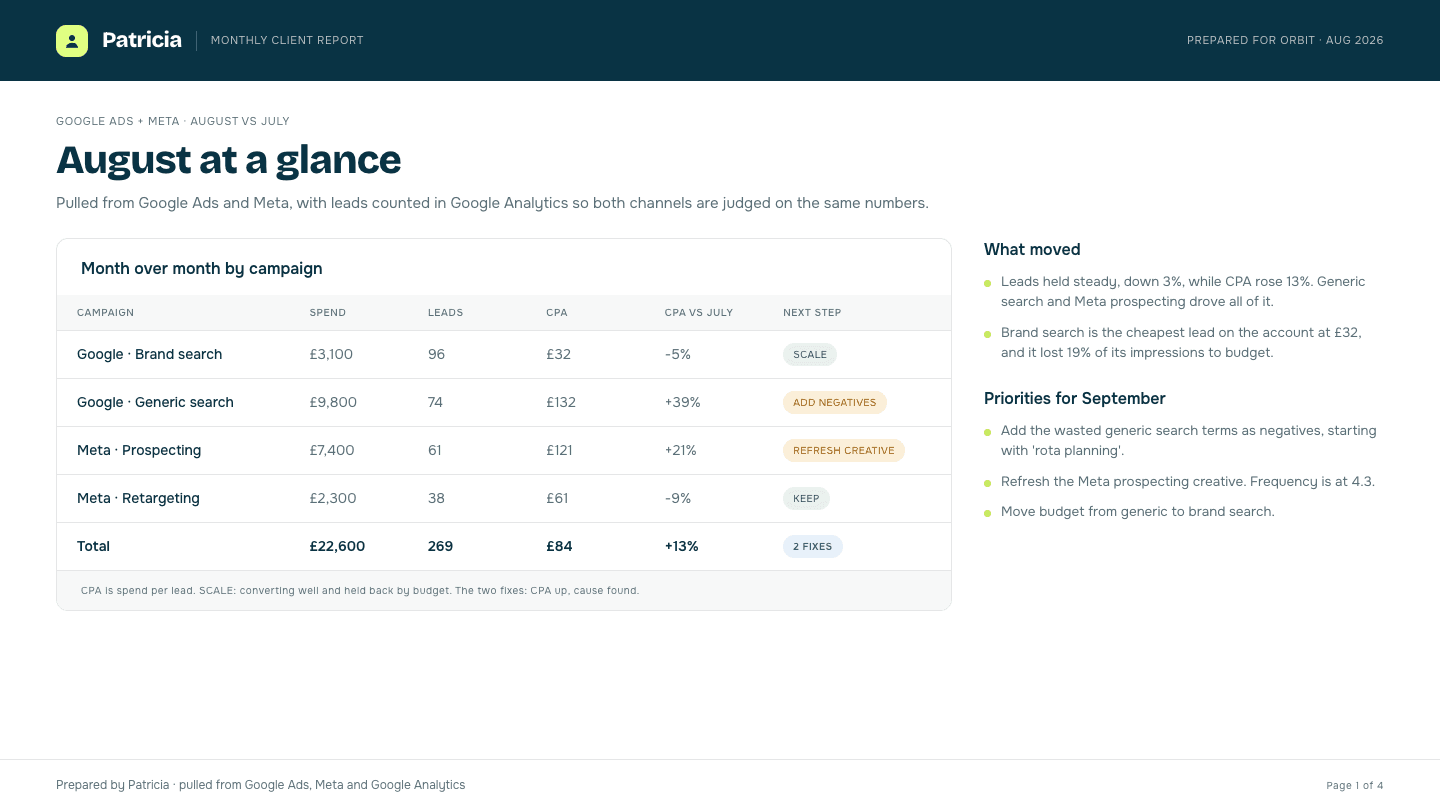
The AgencyAnalytics report has the clearest number on time: 79% of agencies save five or more hours a week, 35% save ten or more. The shift is in where the hours come from. In 2025 content creation led at 58%. In 2026 reporting and performance summaries lead at 42%.
Hubstaff's time-tracking data shows the other side: AI work is only about 4% of tracked hours on teams that use it. My read: AI saves time inside tasks and rarely shows up as a task of its own.
Pricing pressure: clients expect AI to lower the fee
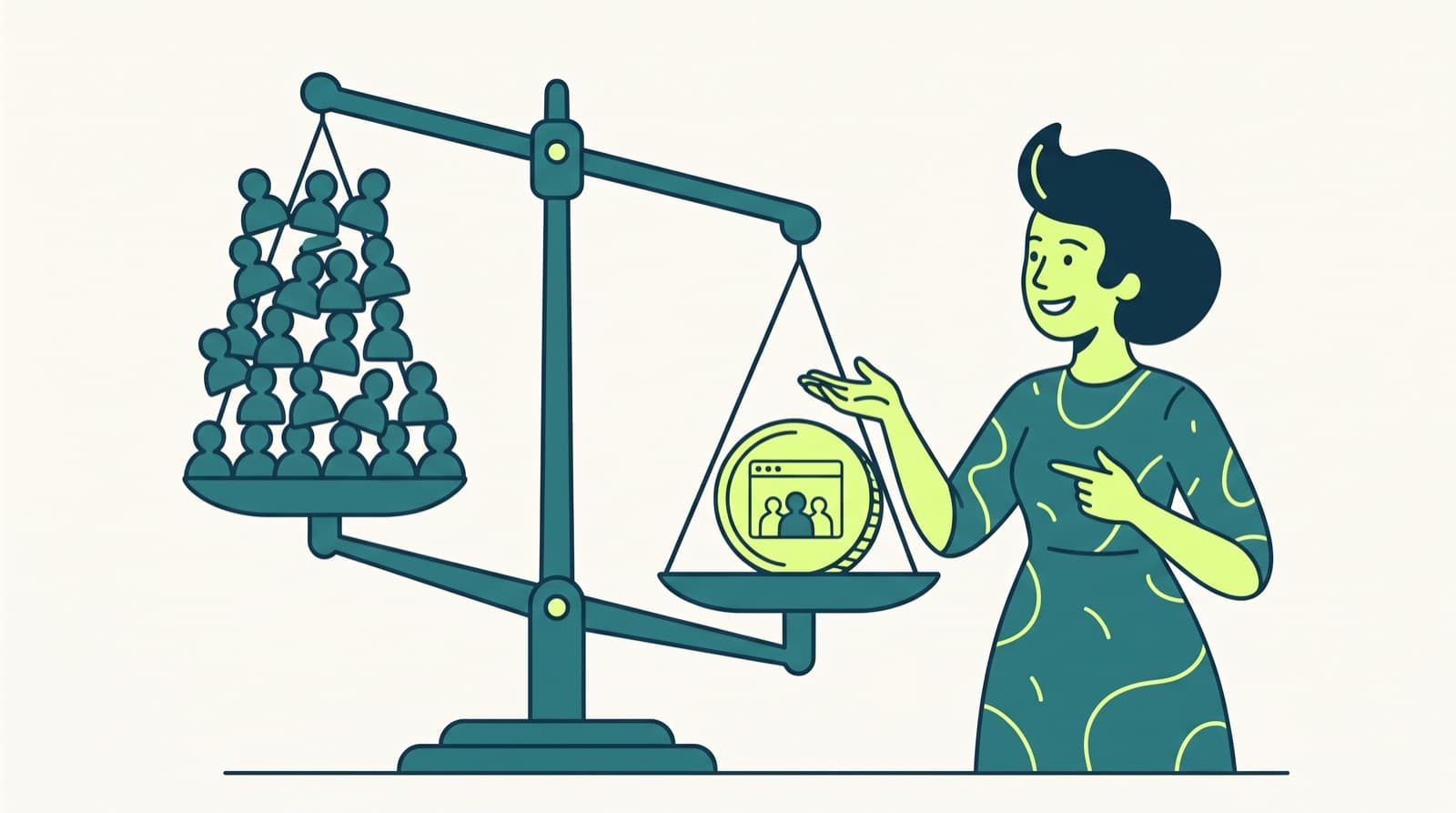
30% of agencies in the AgencyAnalytics survey say clients see their services as worth less, likely because clients assume AI should cut agency fees. Basis puts it more starkly: 90% say AI threatens their main revenue, and 65.3% had clients move work in-house in the past year. Forrester adds that 61% of agencies still book AI as a cost of business, with little direct revenue from it.
Headcount: the forecasts and the surveys disagree
Forrester forecasts 32,000 US agency jobs lost to automation by 2030, and 91% of the agency leaders Sunup surveyed expect AI to shrink headcount. 57% have already slowed or paused entry-level hiring. Productive's March 2026 survey found only 3% report significant staff reductions so far. Read together: agencies are hiring fewer juniors and mostly keeping the team they have.
New services: AI search is the #1 client request
66% of agencies report more client demand for AEO and SEO for AI search engines, the top new service in 2026. Agencies that sell it need a monthly report for it. Our GEO retainer page shows one way to package it.
Part 2: What the work costs with an AI coworker
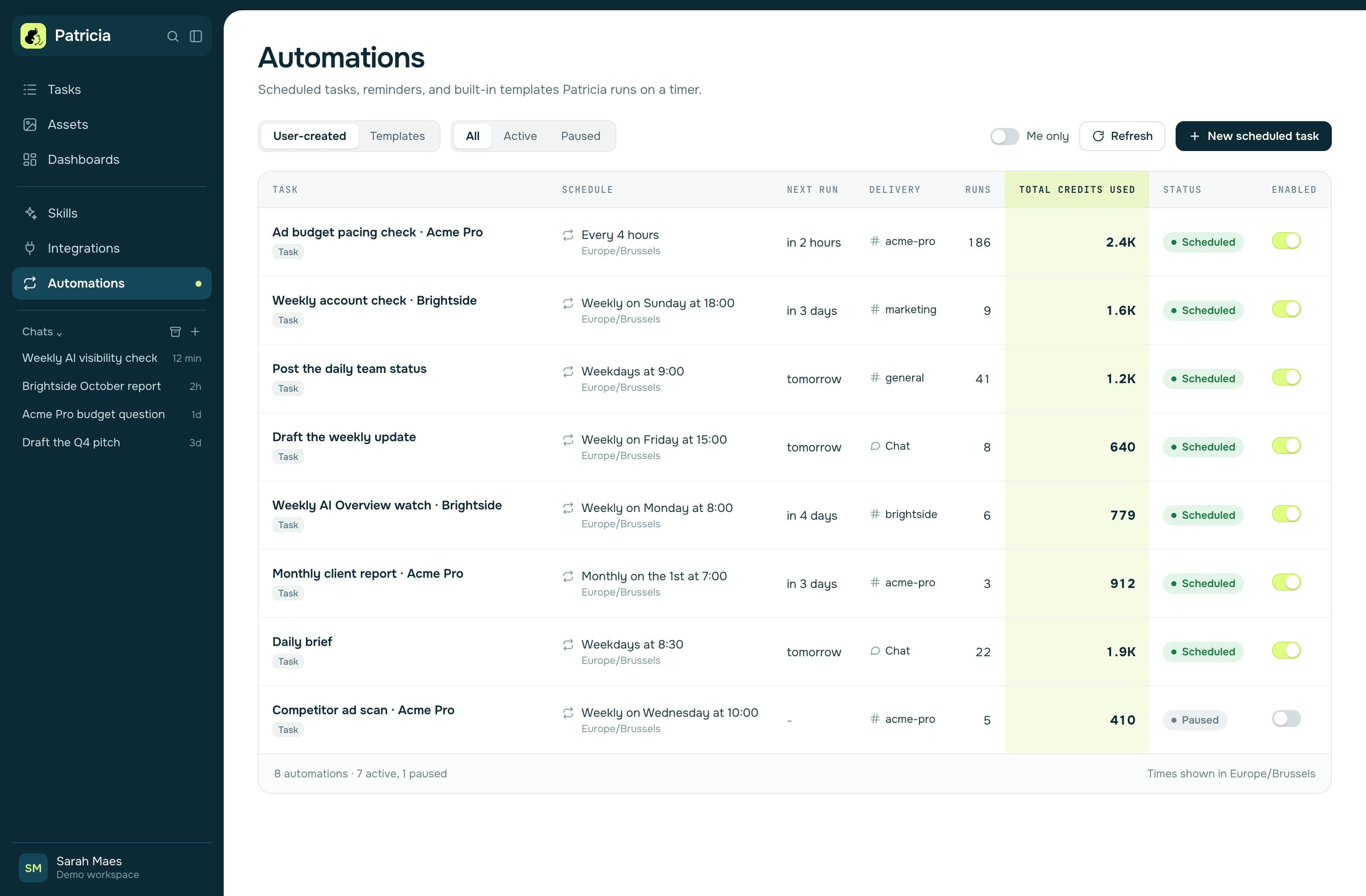
Part 1 says agencies save hours. It rarely says what a single job costs. Here are the typical usage costs per job on Patricia, the AI coworker we make. She works inside Slack and Microsoft Teams and runs the recurring client work: reports, ad spend and anomaly alerts on Google Ads, Meta Ads and LinkedIn Ads, call recaps, briefs, ad variants and SEO drafts.
Pricing: the Founding plan is $45 a month per workspace, every seat included. It includes 20,000 credits every month. Credits never expire and roll over. Extra credits cost $2.25 per 1,000, with up to 25% off in bulk. So one credit is worth $0.00225 at the extra-credit rate.
| Job | Typical credits | Usage cost at $2.25 per 1,000 |
|---|---|---|
| Ad variant | ~56 | ~$0.13 |
| Social post or content brief | ~150 | ~$0.34 |
| Client report | ~300 | ~$0.68 |
| Campaign build | ~1,183 | ~$2.66 |
These are typical figures. A report that pulls more ad accounts or a longer date range uses more credits, and a short brief uses fewer. You can set a monthly spend cap.
A worked month for a small agency with 8 clients
| Job | Runs a month | Credits | Value at $2.25 per 1,000 |
|---|---|---|---|
| Monthly client report, one per client | 8 | 2,400 | $5.40 |
| Posts or content briefs, 4 per client | 32 | 4,800 | $10.80 |
| Ad variants, 20 per client | 160 | 8,960 | $20.16 |
| New campaign builds | 2 | 2,366 | $5.32 |
| Total | 202 jobs | 18,526 | $41.68 |
18,526 credits fit inside the 20,000 included in the $45 plan, so this month costs $45. The 1,474 credits left over roll into next month. If the agency doubled to 16 clients with the same mix, it would use 37,052 credits: 17,052 extra credits cost $38.37, for $83.37 in total.
Compare it with doing the job by hand
The usage cost is the small number. The bigger one is the time your team spends. Run this for each job:
- Hours by hand per run × runs a month × your loaded hourly cost = what the job costs you today.
- Subtract the review time that stays. Patricia drafts; your team still reads before anything reaches a client. She asks before she spends ad budget or sends anything to a client, by default.
- Compare the difference with the credits from the table above.
Example: if a monthly report takes 2 hours by hand at $50 an hour, 8 reports cost $800 of time. If the review takes 20 minutes each, that is $133. The credits for the drafts are $5.40. Swap in your own hours, because they decide the result. The AI coworker ROI guide walks through it step by step.
What jobs cost on our own account
Measured on BetterPic's own Patricia workspace in October 2026, at the base rate of $2.25 per 1,000 credits:
| Job | Credits per run | Cost per run |
|---|---|---|
| Friday client follow-ups | about 94 | about $0.21 |
| Daily ad anomaly watch on Google Ads | about 467 | about $1.05 |
| Weekly roundup and link outreach drafts | about 778 | about $1.75 |
Methodology
- Industry numbers. We opened every source on 3 November 2026 and kept only numbers we found on the publisher's own page or report. Each row names the sample and date the publisher states.
- What we left out. Figures we could only find on secondary sites, or on pages that blocked us, are not on this page. That dropped a Funnel survey and a Gartner CMO figure.
- Weaker sources, kept with a label. Productive and AgencyAnalytics survey partly their own users. Digital Applied sells agentic AI services and notes that true adoption is likely 5 to 10 points lower than its headline. Hubstaff does not publish its sample.
- Different questions. Basis asks agency professionals, Forrester asks US agency decision-makers, AgencyAnalytics asks agency staff and leaders. Compare trends, not exact percentages across surveys.
- Job costs. Typical credits per job on Patricia, valued at the extra-credit price of $2.25 per 1,000. The worked month is an example mix, not customer data.
Cite this page
Free to quote with a link. Please cite the original survey for each industry number.
Hennau, T. (2026, November 5). Marketing agency AI statistics 2026: the benchmark. Patricia. https://www.patricia.app/blog/agency-ai-benchmark-2026FAQ
How many marketing agencies use AI in 2026?
Nearly all of them. Forrester and the 4As report that nine in 10 US agencies use generative AI and half use agentic AI (June 2026). Basis puts AI use at over 99% of agencies, with 59.2% of agency professionals using it daily, up from about 16% in 2024 (April 2026).
How much time does AI save a marketing agency?
In the AgencyAnalytics 2026 benchmarks (494 agency professionals, February to April 2026), 79% of agencies save five or more hours a week with AI and 35% save 10 or more. Reporting and performance summaries are where agencies see the most value (42%).
Is AI lowering what clients pay agencies?
It is putting pressure on price. In the AgencyAnalytics 2026 report, 30% of agencies say clients now see their services as worth less. In the Basis 2026 report, 90% of agency professionals say AI threatens their primary revenue streams, and 65.3% had clients move work in-house in the past 12 months.
Will AI reduce agency headcount?
The forecasts and the surveys disagree. Forrester forecasts that US agencies lose 32,000 jobs, 7.5% of the workforce, to automation by 2030, and Sunup found 91% of agency leaders expect AI to reduce headcount. Productive's March 2026 survey of 174 agencies found only 3% report significant staff reductions so far.
What does a client report cost with an AI coworker?
With Patricia, a client report uses about 300 credits, about $0.68 at the extra-credit rate of $2.25 per 1,000. A post or brief is about 150 credits ($0.34), an ad variant about 56 ($0.13) and a campaign build about 1,183 ($2.66). The $45 Founding plan includes 20,000 credits a month, and unused credits roll over.

Thibaut Hennau is the Growth Manager at Patricia. He runs Patricia's SEO, AI visibility and YouTube.