
A how-to for marketing and SEO agencies that want to add AI visibility, also sold as GEO, to their service list.
To sell AI visibility (GEO) to clients, package it as three parts: a one-off audit that shows which AI answers name the client and its rivals today, monthly tracking of the same buyer prompts, and the content and citation work that moves those numbers. Price the audit as a fixed fee and the rest as a retainer sized by prompts, engines and the work you ship. Prove it with one monthly report: the share of answers that name the client, the pages the engines cite, what you shipped, and what comes next.
GEO (generative engine optimization), also called AI visibility or LLM SEO, is the work of getting a brand named and cited in answers from ChatGPT, Gemini, Perplexity, Copilot and Google's AI features. If you want the tactics themselves, read how to rank in ChatGPT. This page is about turning them into a service a client pays for every month.
Checked 3 November 2026The GEO offer at a glance
| Part | What the client gets | How often | Proof it worked |
|---|---|---|---|
| 1. Audit | A baseline: which buyer prompts name the client, which rivals win, which pages the engines cite, and a gap list | Once, before the retainer | A dated number per engine |
| 2. Tracking | The same prompts re-run against the same rivals, split by date | Weekly or monthly | The trend against the baseline |
| 3. Content and citation work | Answer pages, page fixes, list and roundup outreach, review profiles, Reddit replies | Every week | Client pages and mentions show up in the cited sources |
| Monthly report | One page that ties the three together | Monthly | The client approves next month's plan |
What to sell: the three parts of a GEO service
The AI visibility audit
- What it is
- Write 10 to 30 questions the client's buyers would ask, in their words: "best", "alternatives", price, "is it worth it". Run each one several times on the engines the buyers use, and record who is named, in what position, and which pages are cited. Add a crawl check: OpenAI says sites opted out of OAI-SearchBot "will not be shown in ChatGPT search answers" (OpenAI crawlers), so check robots.txt and the CDN first.
- Deliverables
- The share of answers that name the client, per engine. A rival table. The top cited domains, sorted into own pages, competitor pages, best-of lists, Reddit threads, review sites and videos. The prompts with no mention at all. A 90-day plan.
- Where it stops
- One run proves nothing, because answers change from run to run. Tracking tools also collect answers in different ways, so the ChatGPT app can answer differently from the tool. Say both things in the audit, before the client finds them out.
Monthly AI visibility tracking
- What it is
- The audit prompts, re-run on a schedule against the rivals the client picks. Keep the prompt set fixed for a quarter, or the trend means nothing. Log what you shipped between two runs, so a change in the numbers has a likely cause.
- Deliverables
- Share of answers that name the client, average position, the cited URLs, prompts won and lost, all per engine and split by date.
- Where it stops
- Small samples swing. Ten prompts run once a month is a thin base for a trend, so watch at least 4 weekly reads before you call one. The tools in our AI visibility tools comparison start at 15 to 100 prompts per client on their entry plans.
Content and citation work
- What it is
- The work that moves the tracking numbers, in five lines:
- Answer pages: one page per buyer question, the answer in the first sentence, every number dated and sourced.
- Page fixes: pages that rank but aren't quoted, rewritten passage by passage (see AI search visibility).
- List and roundup outreach: emails to the authors of the best-of lists the engines already cite.
- Review and directory profiles: the review sites that show up in the cited sources for the client's category.
- Reddit replies: written for threads that rank, posted by a person from their own account, with the affiliation disclosed and the subreddit's rules followed.
- Where it stops
- You don't control third-party pages. Many list authors won't reply, and some ask for a fee. A mention on a list that no engine cites does little, so check the cited sources before you pay for anything.
How to price GEO services
We haven't found a public survey of GEO retainer prices we'd trust. The ranges on vendor blogs don't say where their numbers come from, so this section gives you the structures and your cost floor, not a market rate.
- Fixed-fee audit. One price, one baseline, one plan. You can credit it against the first retainer month when the client signs.
- Tracking tier. Priced by the number of prompts, engines, rivals and markets. A client in one country with 20 prompts costs you less to track than one in 3 languages with 200.
- Work tier. Priced by deliverables per month: answer pages, page fixes, outreach targets, review profiles. It works like a content retainer, and it's where your team's hours go.
- Add-on or standalone. For a current SEO client, sell GEO as an add-on with its own line in the report. For a new client, sell the audit first.
Your tracking tool sets the floor. Entry prices on the vendors' own pages, checked 3 November 2026:
| Tool | Entry price | What it buys |
|---|---|---|
| Otterly.AI Lite | $29 a month | 15 prompts, 1 workspace, 4 engines |
| Peec AI Starter | $95 a month | 50 prompts, 1 project, 3 active models |
| Semrush AI Visibility Toolkit | $99 a month per domain | 25 prompts, ChatGPT and Google AI Mode |
| Profound Agency Growth | $99 a month, plus $399 a month per client workspace | 100 prompts per client workspace, 3 engines |
| Patricia (ours) | $45 a month per workspace, every seat included | About 800 credits per client for the monthly AI visibility report, out of 20,000 included credits a month |
The tool sets the floor. The margin sits in the work: the pages, fixes and outreach your team ships each month. Price the work tier on hours, then check the tracking tier covers the tool.

The pitch: show the prospect their own answers
A GEO pitch lands when the prospect sees a rival named in an answer to their own buyer's question. Five steps:
- Before the call, run 10 to 15 of their buyer prompts in ChatGPT and in Google's AI features. Save the answers where a rival is named and they aren't.
- Show the cited sources. The lists, threads and review sites the engine read turn "AI" into a to-do list the prospect can picture.
- Show the first 3 fixes from the gap list, with what each one needs from the client.
- Say what you can't promise. OpenAI's own help page says "Placement is not guaranteed" (ChatGPT search). Promise the work and the measurement.
- Close on the audit, with the baseline as its deliverable and the retainer as the next step.
An opening line you can adapt: "We asked ChatGPT the [12] questions your buyers ask. [Rival] was named in [9] of them. You were named in [2]. Here are the [14] pages it read before it answered."
For a quick first reading on a prospect, the free AI visibility check on patricia.app gives one.
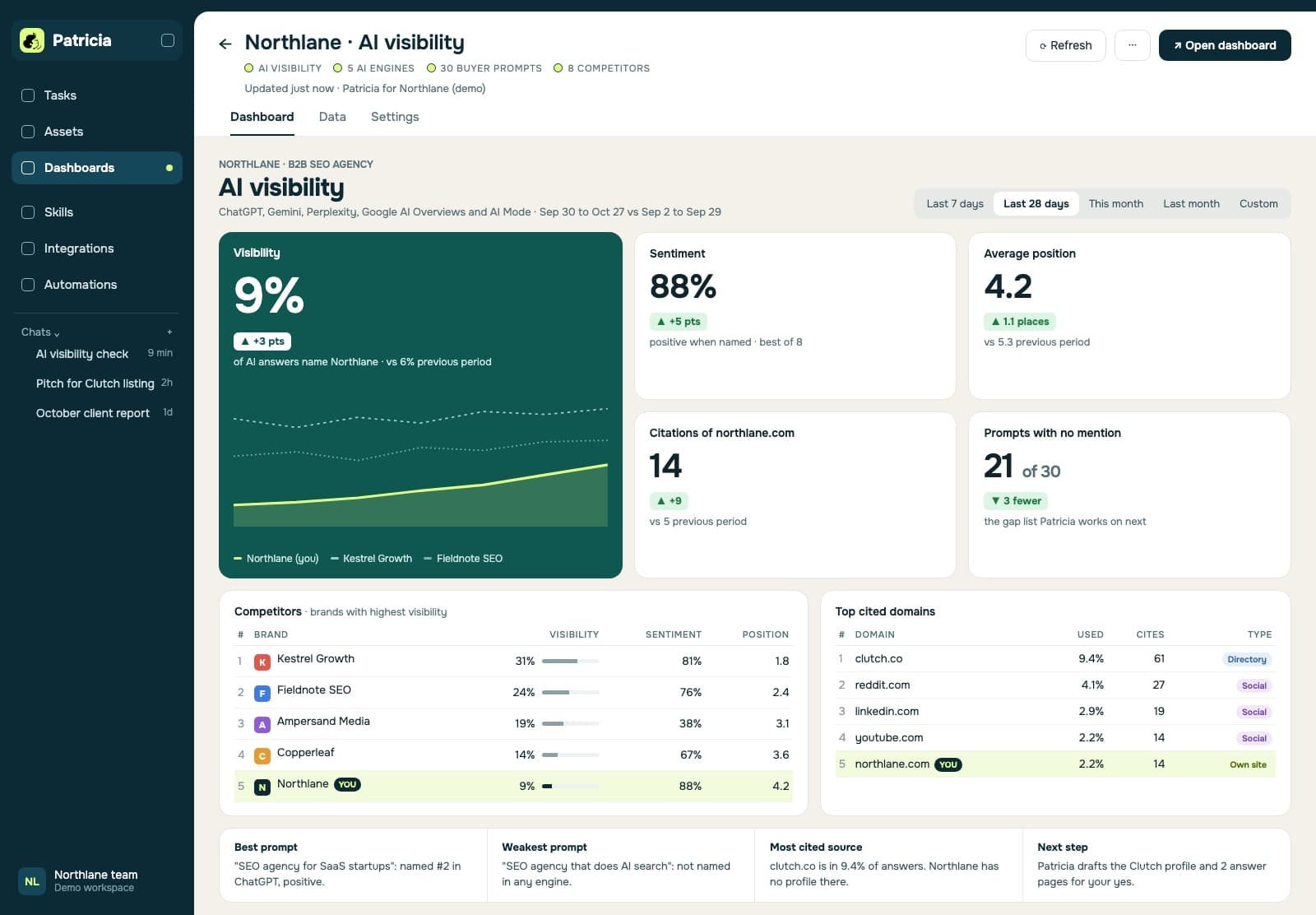
The monthly report your client sees
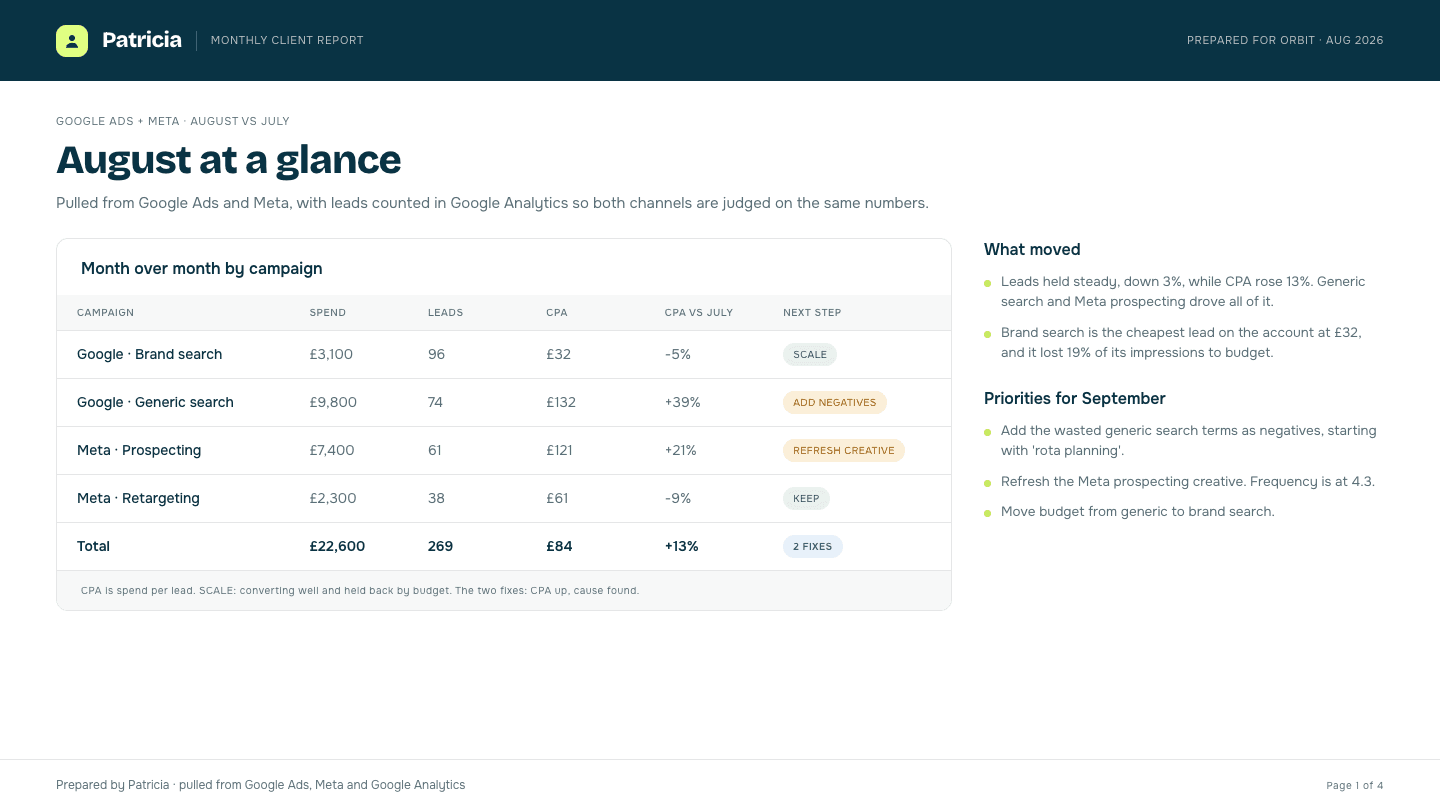
The report keeps the retainer. Give it the same order every month, so the client learns where to look:
- The headline number: share of answers that name the client, per engine, against last month, with the date range stated.
- Rivals: share, position and tone for each rival the client picked.
- Cited sources: the top domains and URLs, with the client's own pages flagged.
- Prompts won and lost since the last report.
- What we shipped: pages, fixes, outreach and replies, each with a link.
- Traffic: Google says AI feature traffic sits inside the Search Console Performance report, under the "Web" search type (Google AI features). Add referral sessions from chatgpt.com and perplexity.ai in GA4.
- Next month's plan, waiting for the client's yes.
Client objections, and what to answer
| Objection | Answer |
|---|---|
| "Isn't this just SEO?" | The base is the same. Google says "There are no additional requirements to appear in AI Overviews or AI Mode, nor other special optimizations necessary." What's new is measuring the answers and earning the third-party pages the engines cite. |
| "Can you guarantee we show up in ChatGPT?" | No. OpenAI says "Placement is not guaranteed." You commit to the prompts, the work and a dated report. |
| "Can't we buy ads in ChatGPT instead?" | OpenAI says "Ads do not influence the answers ChatGPT gives you" (OpenAI on ads). Ads buy a labeled slot beside the answer. |
| "The answers change every time I ask." | That's why the report shows a share across many runs, split by date, never one screenshot. |
| "How does this turn into revenue?" | Track Search Console clicks, AI referrals in GA4 and leads who pick an AI assistant in your "How did you hear about us?" field. Say up front that attribution is partial. |
| "We already pay you for SEO." | Show the lines that are new: prompt tracking, list outreach, review profiles, the AI page in the report. Then price them as an add-on. |
How Patricia runs the tracking and the report for your agency
Patricia runs the routine behind a GEO retainer, and your team approves. She's an AI coworker for small marketing agencies, inside Slack and Microsoft Teams. Per client, she measures how often ChatGPT and Google AI name the client against the rivals you pick, what the engines cite, and which pages sit just off page one.
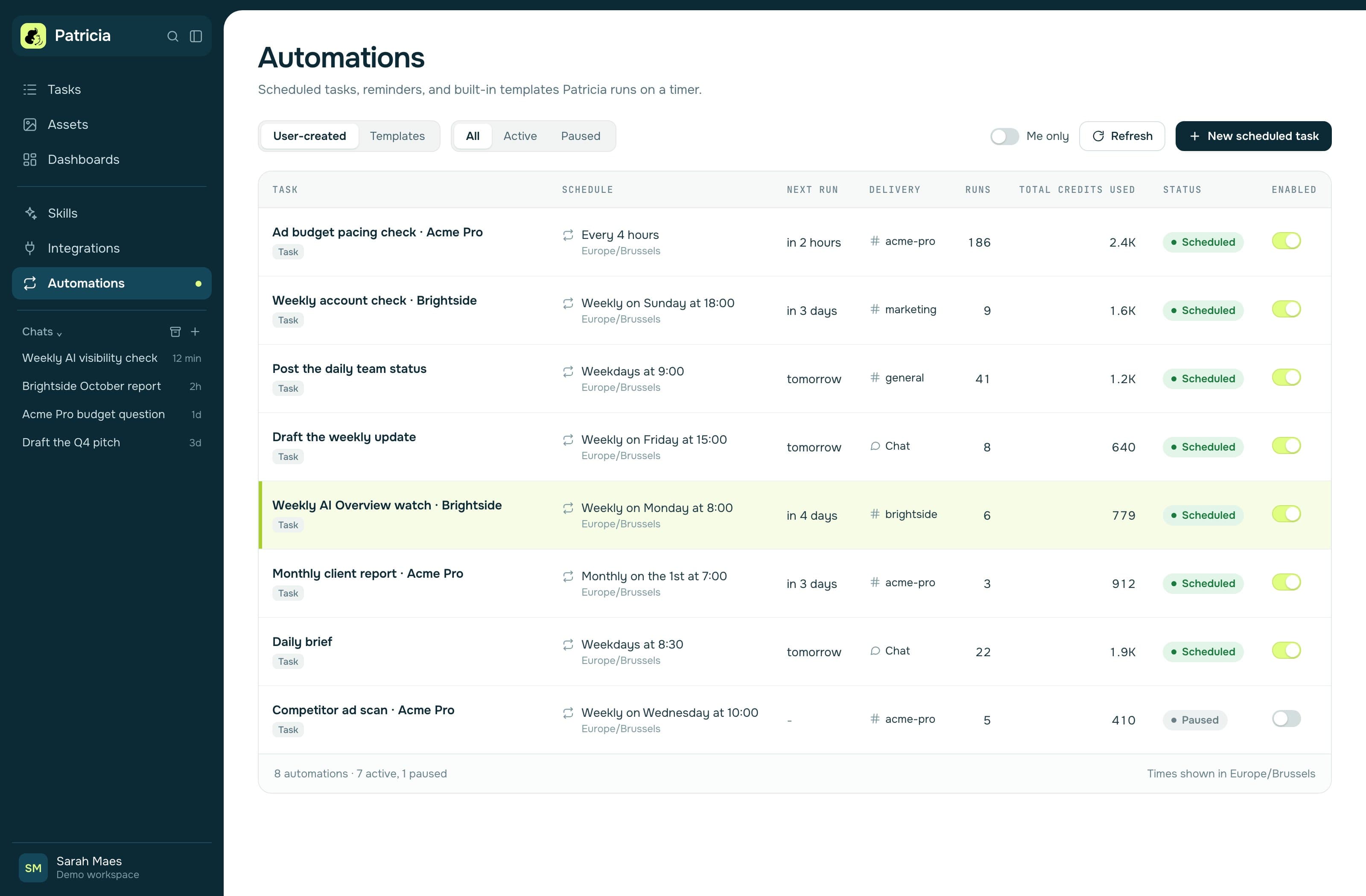
Her week, per client: Monday a search report, Tuesday developer-ready page specs, Wednesday a content brief, Thursday roundup and link outreach, Friday follow-ups. On the 1st, the monthly AI visibility report and the client report, drafted in your agency's voice. The monthly client report has a white-label setting.
Where it stops: her AI visibility report covers ChatGPT and Google AI, not every engine. She doesn't yet match dedicated tools on live dashboards or on the number of models tracked, so if you need those, keep your tool and let her read its output. She never edits a client's site: each fix becomes a ticket in Linear or Notion with the spec attached. Posting and sending wait for a yes in the channel, from you or the client.
Cost: the monthly AI visibility report uses about 800 credits per client. The Founding plan is $45 a month per workspace, every seat included, with 20,000 credits a month that never expire and roll over. Extra credits cost $2.25 per 1,000. Pricing.
FAQ
How much should an agency charge for GEO services?
There's no public benchmark we'd trust yet. Use three structures: a fixed-fee audit, a tracking tier priced by prompts, engines and rivals, and a work tier priced by deliverables. Your tracking tool is the floor: entry plans ran from $29 to $498 a month for one client on the vendors' own pages on 3 November 2026.
What is the difference between GEO and SEO?
GEO uses the same base as SEO: pages that answer the question and other sites that name you. Google says no special optimizations are needed for AI Overviews or AI Mode. GEO adds two things: measuring how often AI answers name the brand, and earning the lists, threads and reviews the engines cite.
How long before a client shows up in AI answers?
There's no fixed time. OpenAI says a robots.txt change for its search crawler takes about 24 hours, but a mention depends on when the cited pages change. Re-run the same prompts weekly and give it 4 weeks or more before you call a trend.
Which AI engines should a client report cover?
The ones the client's buyers use. Start with ChatGPT and Google's AI features, then add Perplexity, Gemini or Copilot if your tool tracks them. Entry plans differ: Otterly.AI Lite covers 4 engines, Semrush's toolkit tracks prompts on ChatGPT and Google AI Mode.
Can an agency white-label an AI visibility report?
Yes, with some tools. SE Ranking sells an Agency Pack with white label for platform and reporting, Otterly.AI gives agency partners Looker Studio reports with their branding, and Patricia's monthly client report has a white-label setting. Check each vendor's agency page before you promise it.
What tools do agencies use to track AI visibility?
Profound, Peec AI, Otterly.AI, Scrunch, AthenaHQ, SE Ranking and Semrush's AI Visibility Toolkit all sell plans that agencies use. Our comparison of AI visibility tools for agencies lists the engines, prompts, starting prices and agency features of each, checked 3 November 2026.

Growth Manager at Patricia